
- Optical connectivity will play a key role in next-generation AI infrastructure
- Laser technologies enable much faster and energy-efficient interconnections
- Companies at the forefront of such innovation are experiencing exceptional demand
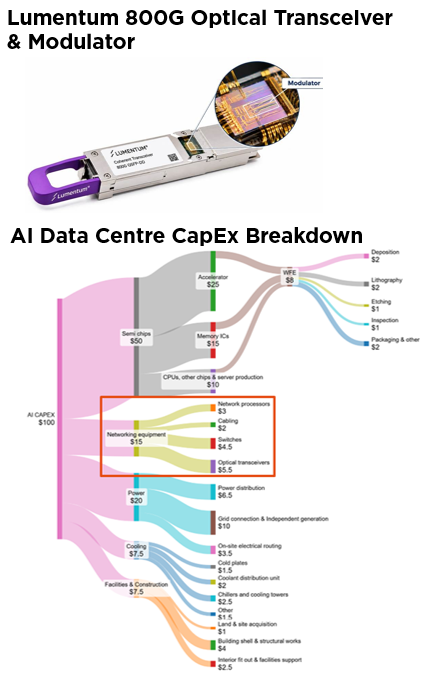
Current and forecasted investment in AI data centres is staggering, with annual spending widely expected to surpass USD 1 trillion by 2030 – up from an estimated USD 800 billion this year. Alongside necessary innovations to contain energy consumption and improve cooling technologies, cabling solutions are also evolving fast. The shift from copper to fibre enables much faster connectivity but also contributes to rocketing up data centre building costs.
Energy and water consumption issues pertaining to data centres have been well publicised, amid growing local community backlash. Globally, data centres today account for 1.5 to 2% of total electricity usage. A single hyperscale facility can consume some 100 megawatts, the equivalent of 80,000 households. As for water depletion concerns, they are heightened by the fact that a majority of AI data centre buildouts over the past few years have occurred in regions of the US that are prone to hydric stress, such as southern Arizona or Texas.
The path towards data centre architectures that are both more efficient from an energy usage standpoint and enable faster data treatment lies largely in innovative cabling solutions. Where the distance is short, copper cables currently remain the favoured option. This applies to connections between parallel-running GPU nodes (specialised server units, equipped with processors, memory and network interfaces) – located right next to each other. As well as to connections between a server and the rack switch (1 to 3 metre distance). Over time, however, high power lasers stand to gradually replace such copper wiring.
For connections that are longer, be they between data centre racks (up to 100 metres) and buildings (2 to 10 km), or even between different data centres (10 to 120 km) and countries (1,000+ km), laser/optical solutions are already well entrenched. Without delving into very complex technicalities, the important point to understand is that transforming a digital data flow into an optical signal requires modulators. And that innovation in this modulator space holds the key to faster and more energy-efficient data centres.
Directly Modulated Lasers (DMLs) – the oldest type of fibre optic modulators – support a speed of 10 Gb per second. Technological advances have already brought about a new generation of Electro-absorption Modulated Lasers (EMLs), offering a speed of 200 Gb per second. And the next stage of Coherent modulators promises even faster performances, ranging from 800 Gb to 1,600 Gb per second.
Among the companies best positioned to benefit from the rapid expansion of optical connectivity are two US-listed photonics specialists, Lumentum and Coherent. The former is a global leader in EMLs, alongside competitors such as Broadcom and Mitsubishi Electric. It is also expanding its presence in high-power lasers for co-packaged optics and optical circuit switches. Coherent, meanwhile, benefits from a highly vertically integrated manufacturing platform that spans lasers, photonic components and finished optical transceivers, positioning it across multiple generations of optical interconnect technology. Both are experiencing exceptional demand: Lumentum’s latest quarterly revenues topped USD 1 billion, up 109% year-on-year, while Coherent’s stood at USD 2.05 billion, up 42% on a pro forma basis.
Such exceptional revenue growth highlights the increasing importance of optical connectivity in next-generation AI infrastructure. As data centres become larger and more computationally intensive, the need for faster, more energy-efficient interconnections is driving significant investment in advanced optical technologies. This comes alongside a broader escalation in AI infrastructure spending, with the largest data centres now representing investments of tens of billions of dollars (vs. USD 1-5 billion for more conventional projects in the past). And it helps explain why hyperscaler capex plans continue to exceed market expectations, quarter after quarter.
Edoardo Giraudi, Equity Analyst
Gaddo Gabetti Davicini, Asset Management Intern
Interest rate gravity vs. Tech levitation
- Winter is coming: growth remains resilient, but the first cold winds are blowing
- Fearful, yet fully invested: a paradox that calls for diversification rather than heroics
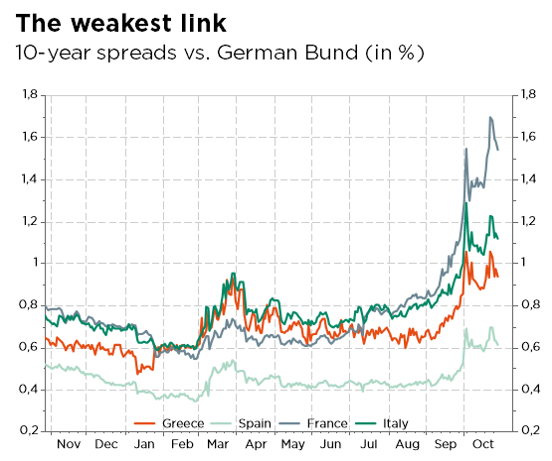
- The weakest link: trimming Eurozone exposure across the board
Markets obey their own laws of physics, and this autumn two are pulling in opposite directions. Gravity, first: inflation is refusing to recede, central banks are hiking again and public finances keep deteriorating. Long-end yields have thus climbed to levels unseen in years, raising the cost of everything from mortgages to sovereign debt. Levitation, second: the AI investment boom keeps delivering earnings growth strong enough to maintain global equity indices close to their highs. So far, neither force has prevailed. Indices remain trapped under a glass ceiling, while the real action is taking place underneath, where rotations have rarely been so brutal. The question for the coming months is which of the two forces will tire first. Unless a third one, still largely absent from market pricing, suddenly enters the equation. A recession would turn the current balance upside down, pulling bond yields lower while bringing earnings, and equities with them, back down to earth.
The broader context is hardly helping the levitation side. The US-Iran conflict is dragging on, with no official reopening of Hormuz in sight. Oil inventories are shrinking just as the northern hemisphere heads into winter, keeping crude firmly above USD 100/bbl and pushing European gas prices up. Politics are adding another layer of uncertainty. In France, the budget battle has spilled onto the streets and pushed the country’s borrowing premium over Germany sharply higher, while in Washington the mid-term elections put the House majority up for grabs, a case of maximum noise for an uncertain signal.
Beyond such noise, the global economy is cooling, but not cracking. How well each country holds up depends on its sensitivity to AI investment, energy prices, higher rates and government spending. The US is likely slowing from a high pace but remains solid, with business surveys still in expansion territory and a labour market where modest hiring has become the new normal, given ageing demographics and lower immigration. By growing modestly, Europe has proved more robust than feared, but its gas storage stands well below comfortable levels heading into winter, leaving its short-term growth prospects at the mercy of the weather and of Hormuz. China is treading water, relying on exports while household demand stays weak. The real problem lies elsewhere: inflation is stuck well above target on both sides of the Atlantic, and not only because of energy (US services prices are still running hot). Developed market central banks are thus turning the screw again, gradually and almost in unison. The Fed, the ECB and the BoJ are all expected to hike once more by year-end, with the SNB the notable exception. Meanwhile, higher bond yields and tighter financial conditions are doing part of their work.
In financial markets, the slight dip in global equities hides some truly extraordinary moves. Tech momentum has given back all of its annual gains, and AI-related stocks have lost about a quarter of their value relative to the broader market since their late-June peak. Momentum funds suffered record outflows, and Korean equities, a favourite way to play the memory-chip boom, underwent a violent correction. Defensives and energy took the lead, Switzerland proved resilient, and the eurozone and emerging markets lagged. The result is a striking valuation gap: the Nasdaq 100 multiple is back to its 2022 trough, while Apple trades at its 2020 peak. Investor positioning also offers a curious paradox: sentiment gauges point to extreme fear, yet surveys show cash levels near record lows, with the largest overweight in technology in six years. In bonds, long-end yields have set new multi-year highs, driven by investors demanding a higher term premium, with the French 10-year rate now flirting with 5%. Credit stress is surfacing at the weakest end of the spectrum, where CCC spreads have widened markedly and AI-related high-yield issuers now trade well above their peers. Gold and silver retreated as real rates and the dollar rose, while oil extended a rally that has seen prices climb by nearly 80% since January.
Our base case has not changed: resilient growth, above-target but not spiralling inflation, and a slow and uneven rate normalisation. What has shifted is the balance of risks around this base case, as fiscal policy keeps working against central banks and the spectre of fiscal dominance grows in several large economies. The bear case would combine several possible accidents such as stagflation forcing much tighter policy, AI unwind or a bond market accident amplified by politics – among many other known or unknown ones. The bull case would need a geopolitical thaw, cheaper energy, faster disinflation and a visible boost to productivity from AI. As such, oil is the swing factor this winter, but the decisive questions, however, are whether core inflation can fall sustainably below 2.5% before bond vigilantes lose patience and AI capex monetisation happens before the invoice is due.
Our overall investment stance remains neutral, although we have chosen this month to prune the branch that looks most fragile. The eurozone has become the weakest link: its political backdrop and energy dependence leave it most exposed to a market reversal, while French debt troubles and contagion risks increasingly tie the ECB’s hands. We have thus downgraded eurozone equities to slight underweight. The region remains a value play and would be a clear winner from cheaper energy, but risks are too acute for now. Elsewhere in equities, strong earnings growth, cheaper valuations and fearful sentiment (often a contrarian buy signal) still balance out rising rates, costly energy and geopolitical uncertainty. In fixed income, we keep a 3- to 5-year average duration but now prefer US Treasuries over European government bonds, which can no longer be considered a clean recession hedge given French and peripheral credit risk. In currencies, we have cut the euro to underweight and keep a slight overweight of the dollar and the Swiss franc, while gold stays slightly underweight.
Fabrizio Quirighetti, CIO & Head of Multi-Asset
External sources include: LSEG Datastream, Bloomberg, FactSet, BNP Paribas Equity Research, Sankey MATIC.