
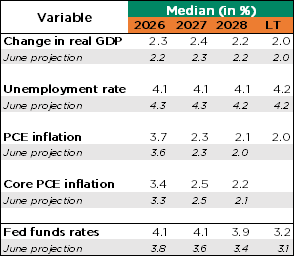
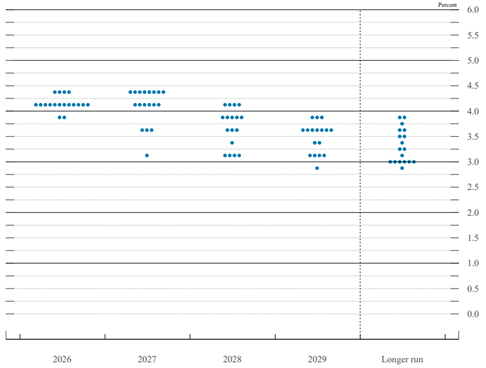
Last week’s rate decisions were really a story about tone, perception and thus credibility, as much as policy. The Fed delivered the hawkish decision markets had been braced for and then some: a 25bp hike to 3.75%–4.00%, its first increase since July 2023, passed by a unanimous 12-0 vote, a decision that came unanimously according to the official FOMC statement. Even the dot plot fell into line behind that unity (less heterogeneity than previously), with the median 2026 year-end projection lifted to 4.1%, implying at least one further hike before year-end. By presenting a genuinely united front and prioritizing the inflation fight above all else, the Fed has effectively laid a ballast under long-term yields; credibility, for now, should keep the long end broadly range-bound. But as ever, macro data will have the final word.
Fed latest Summary of Economic Projections and dot plot: signs of a united front to prioritize inflation target
Half a world away, the BoJ told a very different story two days later. It hiked too, a quarter point to 1.25% as expected, the highest target policy rate Japan has carried since 1995, but the vote split 7-2, with two board members dissenting to hold rather than move. That dissent, not the hike itself, is what moved markets: the yen fell even as the BOJ raised rates, largely because two members voted against the move and the governor offered no promise of further tightening to come. The divergence in conviction -and thus credibility- shows up cleanly in price: the dollar firmer, and (at least for now) the worst of the pressure on US long rates looking contained. The mirror image sits in Tokyo, where the yen is losing ground again and it is far from obvious that this “historic” quarter-point move -for Japanese standard- will be enough to cap the upward drift in long term JGB yields for months.
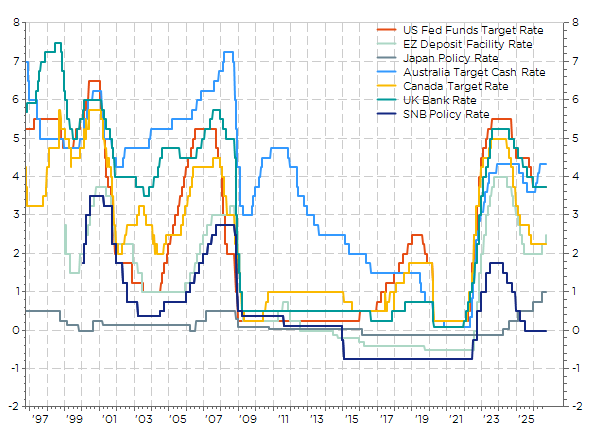
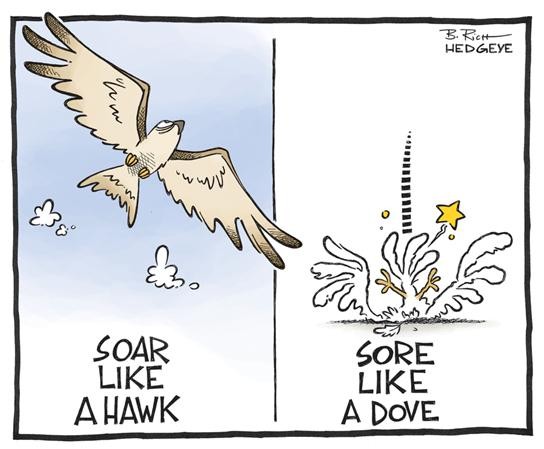
French basketball pundit Laurent Sciarra put it more memorably than any strategist could, in an on-air outburst about 15 years ago that could have gone viral on today’s social media: “you don’t turn a dolphin into a shark” (just listen the first 2 minutes), i.e. you cannot install a killer instinct in a player who simply doesn’t have it in his nature. The same logic applies to the BoJ. Japan’s central bank has not tightened this aggressively in well over three decades. It doesn’t have the institutional muscle memory for it. You can coach technique, but you can’t coach instinct. A gentle dove doesn’t become a hawk overnight, however many quarter points you stack up.
Major central banks policy rate over the last 30 years: when Japanese doves aren’t used to hike
Or maybe nature can occasionally be coached after all. Exhibit A this week: Cagliari, unfancied at the start of the season, sitting fourth after five rounds and four wins (1-0 away win against Udinese this week-end), just a point behind the leading trio of Roma, Lazio and Inter, and already eleven points clear of the relegation line. Not every dolphin stays a dolphin. A message of hope for the BoJ members, investors bullish on the JPY and JGB’s holders, ahead of the next BoJ meeting on October 30th.
Back to men in suits rather than men in boots: from here, everything hinges on the data calendar as far as the Fed and its credibility are concerned. The September jobs report lands October 2, September CPI on October 14, both ahead of the Fed’s next decision in late October. Stronger prints could force the Fed to chase the market and lean even more hawkish, at least rhetorically; softer ones would suggest the heavy lifting is largely done. Right or wrong on a longer term horizon- it’s worth simply recalling what the Fed’s own guidance and market expectations implied about this year’s policy path when we were standing here twelve months ago.
In the meantime, the latest Fed’s decision acts as a drag on the gold rally rather than a driver of it, given how much of the expected tightening is now already in the price. From here, gold’s path over the coming weeks depends on the same data calendar: if the market concludes the Fed has already done enough, bullion should hold up; if September’s inflation and activity numbers surprise to the upside, there’s room for gold to give back further ground.
As yields have climbed, the debate has shifted from whether current levels are justified to whether they’re too high relative to fundamental, i.e. still resilient nominal growth and strong capital demand due to heavy fiscal borrowing and AI-driven capex. But growth and capital demand alone don’t fully explain today’s level either: part of the move is stronger nominal growth and capital demand, part is inflation uncertainty, fiscal concern and a rising term premium. What matters isn’t where yields sit, but that risk assets are still behaving as though the former explanation dominates the second one.
The biggest surprise may be what hasn’t happened: no meaning tightening financial tightening with the absence of a significantly stronger dollar / wider credit spreads. As Fed President Warsh described the quarter-point increase, it has just removed “a dose of accommodation” instead of entering an aggressive tightening cycle. Historically, this combination of higher energy prices, rising yields and a hawkish Fed, would have tightened global financial conditions far more aggressively than it has… Our base case remains a gradually firmer dollar and contained credit spreads rather than a disorderly rally or widening respectively (so no aggressive Fed’s tightening), but the bigger risk is that the dollar and credit eventually ends up doing the tightening the rates has so far failed to deliver.
Which brings us to another contradiction: EM resilience. A hawkish Fed, 5% US Treasury yields and oil barrel above $100 would historically have hit EM assets hard, especially debt and forex. Instead, carry, policy credibility (relative to DM) and a contained dollar have let the asset class absorb the shock reasonably well so far. EM can survive higher rates on its own; surviving higher rates, higher energy prices, as well as a stronger dollar and widening credit spreads eventually, all at once, is a different proposition entirely.
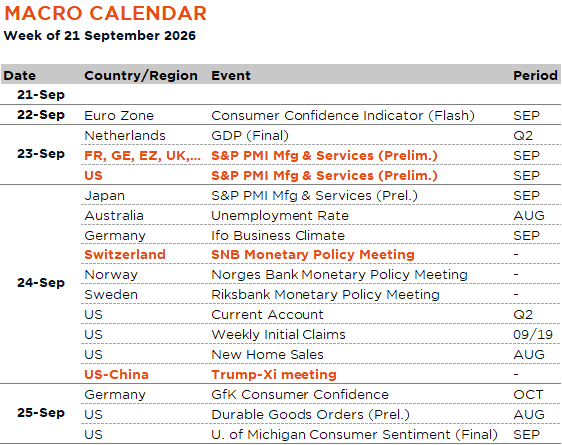
Economic Calendar
Welcome to fall! It’s not just the leaves that are falling this year… The CDU, as well as the German Chancellor Friedrich Merz eventually at some point, are, too. Two weeks after a crushing defeat in Saxony-Anhalt, Friedrich Merz’s CDU party did even worse yesterday. In Mecklenburg-Vorpommern (MWP), the AfD topped the poll with 38%, while the CDU failed to clear the 5% threshold. This had never happened before in the CDU’s 80-year history!? In Berlin, the CDU did far less badly with about 19% of the vote, but it has fallen behind the left-wing Left party, Die Linke (circa 25%), which advocates the expropriation of parts of the local housing stock… In both cases, a populist protest party thus became the strongest political force, the right-wing AfD in MWP and the left-wing Left in Berlin. And to add insult to injury, Greek Finance Minister encourages Germany to implement reforms in a recent interview released in the Handelsblatt.
To stay on the topic of (geo)politics, the summit between US President Trump and China’s President Xi will likely make a lot of Bloomberg headlines on Thursday. The immediate goal is likely to extend the truce and possibly trim some tariffs. Bilateral trade has fallen almost 25% from early-2025 levels, with only tentative signs of recovery lately. As a result, the US deficit with China has narrowed to $165bn, down from over $300bn at the end of the Biden administration, though the US overall deficit with the rest of the world has widened. Beyond trade, tech (AI, rare earths) and geopolitics (Taiwan) remain other friction points. Finally, there will be an UN General Assembly running all week in New York, offering a key venue for diplomatic efforts on the Russia-Ukraine and the US-Iran ongoing conflicts.
Other than that, the economic calendar is pretty light this week with the global September flash PMI indices as the main data highlight (Wednesday). They will provide an updated read on activity across the major economies, which is expected to remain solid in both the services and manufacturing industries (the consensus doesn’t expect meaningful changes).
Central bank decisions are also due in Switzerland, Norway and Sweden, with the SNB, the Riksbank and the Norges Bank respectively, which will each meet on Thursday. While the probabilities of a hike from the SNB (policy rate at 0%) and Riksbank (1.75%) are close to nil, markets are pricing in about 60% odds for a 25bps increase to 4.5% in Norway.
Other notable US economic releases include August new home sales (Thursday), durable goods orders and University of Michigan Consumer sentiment (both on Friday). In Europe, apart from the September flash PMI indices, we will get many other sentiment indicators, including the Eurozone consumer confidence (Tuesday) and the German Ifo (Thursday).
Note finally that Japanese markets are closed until Wednesday for the three-day Silver Week holiday.
This is a marketing communication issued by DECALIA SA. It is neither directed to, nor intended for distribution or use by, any person or entity who is a citizen or resident of or located in any locality, state, country or jurisdiction where such distribution, publication, availability or use would be contrary to law or regulation. The information and data presented in this document are not to be considered as an offer or invitation to buy or sell any securities or financial instruments nor to subscribe to any services. The information, opinions, estimates, calculations etc. contained in this document reflect a judgment at the original date of publication and are subject to change without notice. Investments in any securities or financial instruments may not be suitable for all recipients and may not be available in all countries. This document has been prepared without taking account of the objectives, financial situation or needs of any particular investor. Before entering into any transaction, investors should consider the suitability of the transaction to individual circumstances and objectives. Any investment or trading or other decision should only be made by the client after a thorough reading of the relevant product term sheet, subscription agreement, information memorandum, prospectus or other offering document relating to the issue of the securities or other financial instruments. Where a document makes reference to a specific research report, the document should not be read in isolation without consulting the full research report, which may be provided upon request.