
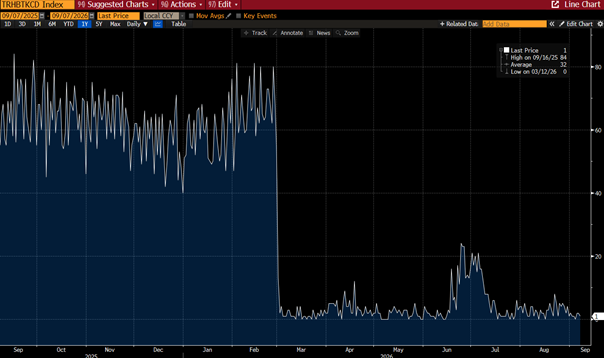
Equities and credit are trading near their highs, but above that apparent calm hangs at least one genuinely uncomfortable thread: energy prices. The trigger isn’t hypothetical as the Strait of Hormuz has been effectively paralyzed since end of February, with daily tankers crossings down from about 60 to basically none, Gulf crude exports divided by two to roughly 9mio b/d (direct crude flows through the strait itself collapsed to 5mio b/d in Q2, versus 20-21mio before the conflict). For a reminder and to put these figures in context, the world economy runs on roughly 100-105mio barrels of oil a day. So, that’s a meaningful dent.
Tanker Vessels Crossing the Strait of Hormuz
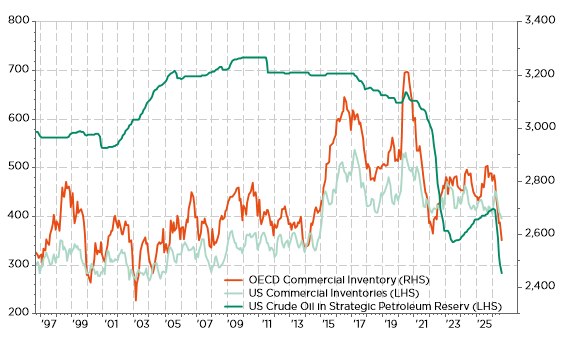
The buffers that would normally absorb such a shock are getting thinner than usual: the US Strategic Petroleum Reserve sits below 300mio barrels (its lowest since the early 1980s), while commercial crude stocks remain also below their five-year average.
US Strategic Petroleum Reserves & US and OECD commercial inventories
Worth also separating two stories that often get conflated: the price of crude and the price of what comes out of it. Brent has actually fallen about 25% from its April peak of $120/bbl to around $90, yet the US Gulf Coast diesel crack spread topped $100/bbl in August, a record, exceeding even 2022. Crude isn’t scarce; refining capacity is with an estimated 4.5mio b/d (-5.5%) has been lost globally since Q2, concentrated where crude is produced (the Gulf, Russia) rather than where it’s consumed. A surprise 17.4mio-barrel weekly build in US commercial crude, the largest since January 2023, has even capped the crude price while the downstream product market stays critically tight: crude piling up, diesel running short, at the same time.
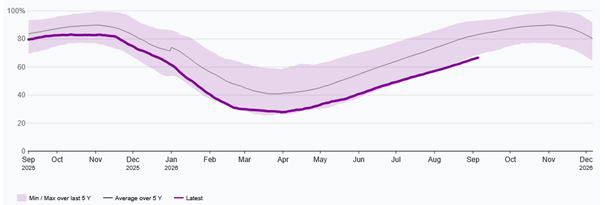
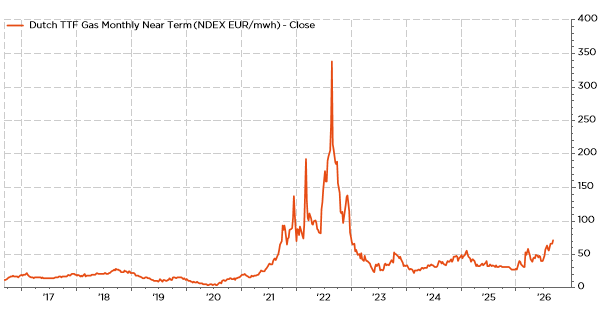
On natural gas, Europe carries the sharper end of the risk. Storage stood at 66.6% as of Friday, the lowest reading for the date since records began in 2011. TTF European gas price has responded, trading above €70/MWh, a three-year high. Norway now supplies roughly a third of European gas imports and LNG about 30%, some of its Qatari volumes are unlikely to return before early Q4 given the Hormuz mine-clearance timeline. Some analysts think prices may need to clear €100/MWh to pull enough flexible US LNG cargoes away from Asia. Chain the pieces together, assuming a cold, low-wind, low-rainfall winter plus no durable Hormuz resolution, and storage could empty fast enough to push Q1 2027 into genuinely disruptive territory. The relief valve, historically, has come from Asia: Japan has diverted surplus cargoes to Europe before and continues reselling record LNG volumes abroad rather than consuming them domestically, helped by nuclear restarts, exactly the kind of price-induced reallocation that could cushion the worst outcome.
EU Gas storage level
European Gas price (futures contract, €/mwh)
The seasonal forecast, for what it’s worth, leans the other way. A record-strength Super El Niño, peaking in November-December with sea-surface anomalies possibly above +3°C, has historically brought Europe a milder, wetter, windier winter (i.e. the opposite of the downside case) though Europe’s signal is less clean than North America’s, and a stratospheric polar vortex disruption in January could still deliver a cold snap against that mild backdrop. As the joke goes, why did God create economists? So that weather forecasters would look credible by comparison… For sure, when stacking a 3-month weather call on top of a geopolitical call and a market call really does mean compounding three unreliable forecasts at once.
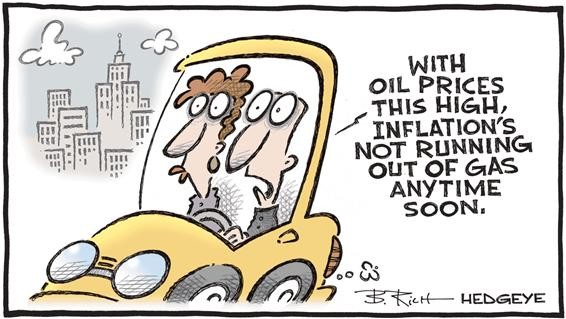
There’s a broader policy point worth making here, and it’s really the bond-market side of this whole story. Central banks are well-drilled at leaning against demand shocks (tighten into overheating, ease into recession) and that toolkit worked reasonably well for the past decades. The last several years, since the Covid outbreak, have instead delivered a string of supply shocks: the war in Ukraine, the war in Iran, the tariff war, geopolitical fragmentation, and now AI-driven capex and the subsequent labor disruption still to come if any. Central banks are structurally less well equipped to deliver on their mandate against that kind of shock, and the current energy squeeze is simply the latest entry on the list. So far, the world has absorbed these shocks better than feared. However, the US inflation picture remains too diffuse, too high, and too persistent for comfort, and the policy backdrop doesn’t help: a new Fed chair whose pronouncements carry all the clarity of the Delphic oracle, a Treasury secretary showing visible signs of nerves, and an unpredictable president. Layer on an ageing Europe where social spending will keep weighing inexorably on budgets, and there are plenty of reasons for markets to revisit the risk premium attached to holding the debt of over-indebted sovereigns. The recent rise in long yields doesn’t look excessive at this stage (if anything it looks like a reasonable repricing) and it’s landing hardest on the countries with the weakest fiscal and political footing. A renewed energy shock this winter would only add fuel to that particular fire.
So, hedging a low-probability, high-impact, badly-timed risk directly tends to impossible as it will carry expensive opportunity costs if the shock doesn’t land on schedule. A cheaper-to-hold expression may be an exposure to currency (bonds) that would benefit mechanically from a sustained energy spike: long currencies such as NOK and CAD -with solid public finances-, funded eventually -for the bravest- against short INR and KRW where the RBI and Bank of Korea are caught between currency defense and growth support. Adding some higher-carry, lower-quality oil exporters (BRL, MXN, COP) lifts the yield at the cost of patchier fundamentals. No easy, risk-free fix but perhaps some ways to mitigate it.
Anyway, Damocles’s story was never really about catastrophe, but about complacency: the feast stayed lavish and the throne stayed gilded, but nothing tasted the same once the sword became visible. Markets can keep enjoying the feast through a mild winter. The point of the fable is just that the sword not having fallen yet doesn’t mean it has stopped hanging.
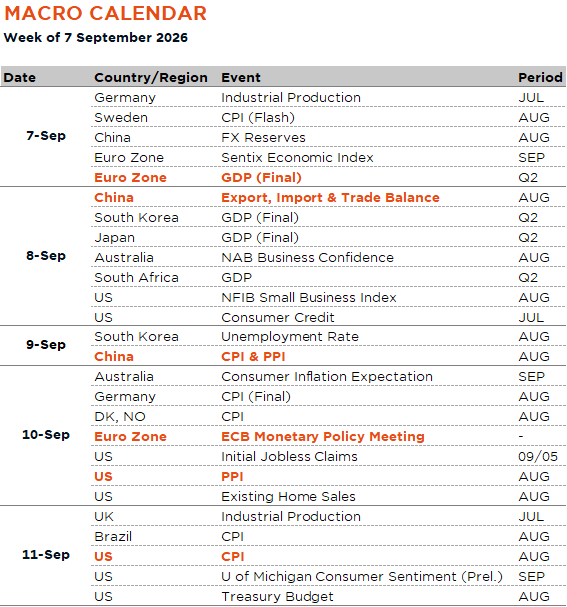
Economic Calendar
After the strong employment report released last Friday, the focus this week will be on the August US CPI report (Friday), preceded by the PPI on Thursday, especially after the recent comments from Fed Governor Christopher Waller, who stated he is willing to support maintaining the policy rate if inflation makes ongoing progress toward the Fed’s 2% goal, but if the August inflation data turns out higher than expected, he would consider supporting a rate hike at the next Fed meeting next week, on September 16… So, the consensus expects August’s headline CPI to come in at +0.4% MoM vs. +0.1% previously and core to print +0.2% as in July, which would translate into 3.4% and 2.5% annual rate respectively. Thursday’s PPI data will also be important to get a sense of the readthrough to core PCE (headline and core PPI are foreseen at +0.4% and +0.3% MoM respectively vs. +0.0% and +0.2% in July).
On Thursday, we will also get the ECB’s monetary policy decision, where a 25bps hike to 2.5% is widely expected. More importantly, investors will follow closely President Christine Lagarde press conference, as well as digging into the updated economic projections, in order to gain some insights on what could prompt the central bank to hike further.
Other key economic data releases include the Q2 final GDP reading for the Euro Area and industrial production in Germany (Monday), trade and inflation reports in China (Tuesday and Wednesday), and the preliminary University of Michigan consumer sentiment, including inflation expectations, for September. Otherwise, the US economic week will start quietly, with markets closed today for the Labor Day holiday… which will give investors who are Cagliari (or Lecce) fans a good reason not to linger at the office tonight and to go watch the Cagliari-Lecce match scheduled for 6:30 p.m. on Matchday 3 of Serie A.
Finally, corporate earnings for this week include Inditex on Wednesday and Adobe and Oracle on Thursday.
Turning to and concluding with (geo)politics, the agenda is quite busy with:
- The consequences for Germany’s political landscape after the AfD secured circa 44% of the vote yesterday at the Saxony-Anhalt state election. This is its strongest result in any German election to date, above polls expectations and more than double its support from 2021 (<21%). In the same time, Chancellor Merz’s CDU slumped to 17% vs. 37% in 2021… its weakest result in the state, as voters expressed growing frustration over economic stagnation, energy costs and migration policy.
- On Tuesday, Canada’s counter-tariffs on US imports enter into force.
- On Wednesday, the US Treasury’s expanded long-end US Treasuries liquidity-support buybacks will kick off and last until beginning of November. For a reminder, the size of operations for the long maturity bonds (10-year and above) will at least double with current maximum size per operation of $2bn increasing to at least $4bn…. I highly doubt there will be a significant impact but it may either impedes somewhat the curve to steepen or help it to get flatter to some extent, especially if the Fed hike rates more/faster than expected or economic activity slows down.
- The US Republican Party will hold its first midterm national convention in Dallas on Wednesday and Thursday, where President Trump and Vice President Vance are expected to deliver speeches.
This is a marketing communication issued by DECALIA SA. It is neither directed to, nor intended for distribution or use by, any person or entity who is a citizen or resident of or located in any locality, state, country or jurisdiction where such distribution, publication, availability or use would be contrary to law or regulation. The information and data presented in this document are not to be considered as an offer or invitation to buy or sell any securities or financial instruments nor to subscribe to any services. The information, opinions, estimates, calculations etc. contained in this document reflect a judgment at the original date of publication and are subject to change without notice. Investments in any securities or financial instruments may not be suitable for all recipients and may not be available in all countries. This document has been prepared without taking account of the objectives, financial situation or needs of any particular investor. Before entering into any transaction, investors should consider the suitability of the transaction to individual circumstances and objectives. Any investment or trading or other decision should only be made by the client after a thorough reading of the relevant product term sheet, subscription agreement, information memorandum, prospectus or other offering document relating to the issue of the securities or other financial instruments. Where a document makes reference to a specific research report, the document should not be read in isolation without consulting the full research report, which may be provided upon request.