
KEY TAKEAWAYS:
1. The next market leaders may be those returning capital, not spending it. As AI capex eventually peaks, cash generation and capital allocation could become more important drivers of returns.
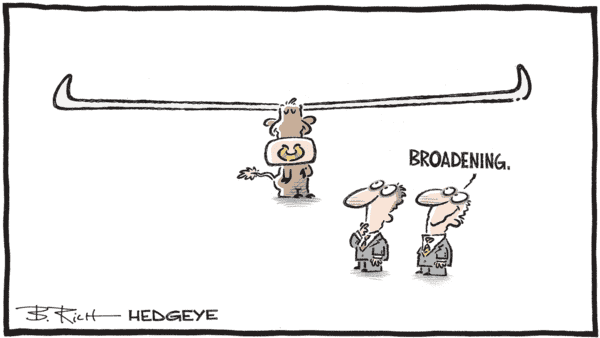
2. Diversification matters. As market leadership broadens, investors should look beyond the usual mega-cap technology names for the next sources of returns.
3. Boring compounders can deliver exceptional returns. Disciplined share buybacks can quietly drive EPS growth and compound shareholder wealth, even when underlying profits barely grow.
There was no shortage of subjects this week: The Fed’s hiking debate, a surge in cyber-attacks, Anthropic’s blockbuster IPO, and enough market volatility to make you check your screen twice before breakfast. But with Fabrizio still on holiday, I decided to look further ahead: when AI capex is no longer driving earnings growth, what comes next?
Before looking further ahead, here’s where markets stand this morning. Futures are bouncing after a weekend of support measures in Asia and a softer tone from Washington. Treasury Secretary Bessent has also left the door open to Jensen Huang’s return. Asked about the President’s suggestion that Jensen should get his job back, Bessent was reminded that he had previously called for the board to look outside the company. His response? “Well, Jensen is on the outside now.” You have to appreciate the irony.
Still, the AI trade is unwinding, and fast. Here are a few breathtaking statistics that would have sounded like science fiction just months ago:
- The S&P 500 fell almost 12% from its 6 October peak in just 33 trading days, one of the 15 fastest corrections since 1928. Last week alone, 94% of its members fell.
- NVIDIA has lost $2.7tn of market value in six weeks, more than the value of any S&P 500 company outside the five largest.
- The S&P 500 closed the week 4.1 standard deviations below its 50-day average, a reading not even the 2020 Covid crash produced.
- Coca-Cola now trades on a higher P/E than Microsoft (29x vs 26x). Let that sink in.
A sharp slowdown is already being priced in. The S&P 500’s forward P/E has fallen from 22x in January to around 16x, while consensus expects earnings growth to halve next year. Yet the bigger question remains: how much more can the AI investment cycle deliver? Hedge fund manager Dan Loeb estimates that the AI build-out will require an additional $2–3tn in annual revenue, against roughly $6tn in global IT spending today. Goldman, meanwhile, expects the AI spending growth to peak in the first half of 2027.
The AI trade may well bounce, but it cannot drive market returns indefinitely. As the investment cycle matures, investors may start looking beyond companies spending billions on growth and towards those generating enough cash to reward shareholders. So, the question for 2027 is not just who will spend the most, but who will return the most. Think of a company as a pizza: profits are the pizza, shares are the slices. When a company buys back and removes its own shares from circulation, the pizza stays the same size, but there are fewer slices to go around. Each remaining share represents a larger claim on the business. If the outstanding share count falls by 5% in a year, earnings per share can rise by roughly 5%, even if total profits remain unchanged. No new data centers, no additional GPUs, no trillion-dollar AI commitments. Just capital allocation and a little financial discipline. In a market increasingly questioning the sustainability of AI-driven growth, that starts to look rather attractive.
The shift is already visible among the hyperscalers. Alphabet and Meta, once buyback champions, are now issuing shares to help fund their AI ambitions. The irony is striking: former buyback kings are competing for the very capital they once returned to shareholders. They may well resume repurchases once AI spending peaks and cash flows catch up. For now, however, the opportunity may lie in businesses with strong free cash flow, sensible valuations and disciplined buybacks.
Don’t just take my word for it. The historic numbers are compelling. Over the past decade, AutoZone and HCA Healthcare each retired around 44% of their shares, Marathon Petroleum 48% and Apple roughly a third. Their annualized total returns ranged from around 16% for AutoZone to almost 30% for Apple, compared with 14% for the S&P 500. A classic academic study found that companies announcing buybacks outperformed the market by around 12% over the following four years, with the outperformance reaching roughly 45% among cheaper, value-oriented stocks. In 2026, the S&P 500 Buyback Index returned almost 7%, against less than 2% for the broader S&P 500.
Of course, buybacks have not always been the winning trade. Over the past decade, the index lagged when owning mega-cap technology was practically all that mattered. But that is precisely the point: market leadership changes. If the next leg of the market is less about who can spend the most and more about who can generate and return the most cash, buybacks may be ready for their moment in the sun.
But not every buyback deserves investors’ attention. What separates the good ones from the bad?
Three things matter: they are funded by free cash flow rather than debt, they actually shrink the share count rather than just mop up shares handed out to employees, and they are done at sensible prices. UK retailer Next is a good example of discipline: it only buys back its shares below roughly 12.5 times pre-tax profit. Get it wrong and the maths stops working. Biogen retired 38% of its shares over a decade and its stock still lost 65%. Fewer slices don’t help much if the pizza is burning.
So, perhaps it’s time to focus less on how much companies plan to spend and more on how much they can return to shareholders.
Next week, Fabrizio returns and I hand back the pen. Giving things back, after all, seems to be the theme of the day.
Christophe Reuter, Portfolio Manager
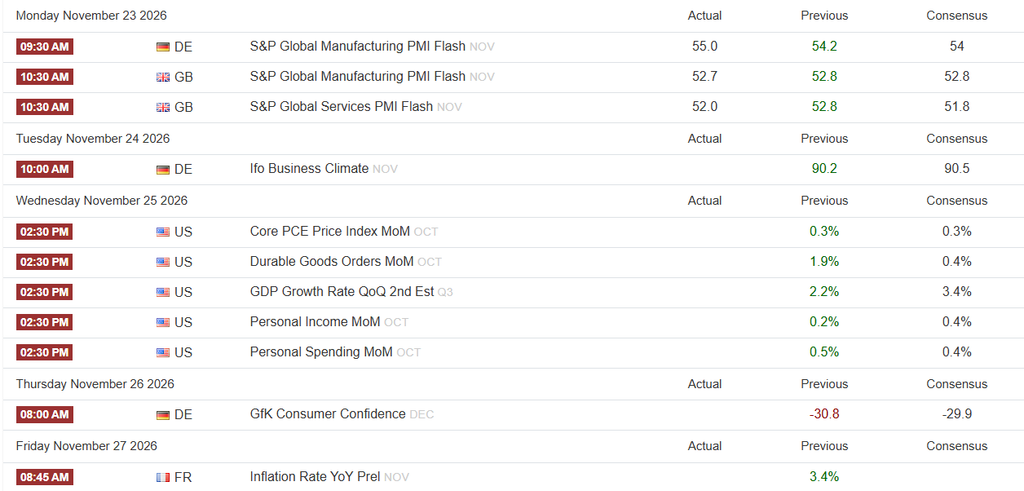
Economic Calendar
On the macro front, today’s flash PMIs offer a first test of whether the market turmoil is spilling into the real economy. On Wednesday, October core PCE and the Beige Book arrive two weeks before a December Fed hike that markets now treat as a done deal. Yet commodities are falling, inflation expectations are near their lows for the year and financial conditions have tightened sharply, to the point that Treasury Secretary Bessent has already warned of a policy mistake. For now, the hawks still hold the microphone, and the real tests come in December with payrolls, the Fed meeting and November CPI. In between, Wall Street takes Thursday off for Thanksgiving, and thin holiday liquidity could amplify any moves.
Source: Trading Economics
This is a marketing communication issued by DECALIA SA. It is neither directed to, nor intended for distribution or use by, any person or entity who is a citizen or resident of or located in any locality, state, country or jurisdiction where such distribution, publication, availability or use would be contrary to law or regulation. The information and data presented in this document are not to be considered as an offer or invitation to buy or sell any securities or financial instruments nor to subscribe to any services. The information, opinions, estimates, calculations etc. contained in this document reflect a judgment at the original date of publication and are subject to change without notice. Investments in any securities or financial instruments may not be suitable for all recipients and may not be available in all countries. This document has been prepared without taking account of the objectives, financial situation or needs of any particular investor. Before entering into any transaction, investors should consider the suitability of the transaction to individual circumstances and objectives. Any investment or trading or other decision should only be made by the client after a thorough reading of the relevant product term sheet, subscription agreement, information memorandum, prospectus or other offering document relating to the issue of the securities or other financial instruments. Where a