
As usual, let’s start with football. This weekend in Serie A, Cagliari got their season back on track with an important win over Frosinone: the Sardinians beat the Ciociari 1-0 at the Unipol Domus on Saturday, thanks to a splendid goal from Michel Ndary Adopo. It was something of a clash of the outsiders, two of the pleasant surprises of the early season. Frosinone arrived in great shape with a chance to record three consecutive Serie A wins for the first time in their history. Cagliari, however, had other plans. A good reminder that outsiders are often written off too quickly, and that is exactly where I want to go this week. Because in markets too, the outsiders deserve a second look.
In the meantime, my conviction is that the selling is exhausting, but not the bull market yet. Extreme liquidation and washed-out positioning are likely creating an increasingly attractive entry point for a year-end rally, even if one final move lower always remains possible. Technology, led by AI, the champion everyone had crowned, has turned into the underdog: it has gone from being priced for perfection to being priced for disappointment. Valuations have reset sharply indeed, and political pragmatism should reignite a selective AI recovery at some point. That sets up what could well be the umpteenth pain trade for active managers, namely a reversal of the recent rotation with technology leading the recovery, initially funded by selling defensives, before the rally broadens. In short, the bull market may have further to run.
But in case I am wrong, which happens in just under 50% of cases, and the correction continues with tech and AI collapsing further, and leading to a recession, there are two places where equity investors could take shelter while waiting for better days: India and the US residential housing market.
India has just delivered its best weekly performance since 2021, and the question is whether this marks the start of a sustained recovery or simply a short-term refuge while the AI trade finds new ground. What stands out is a rare confluence of global and domestic tailwinds. The Democratic “blue tsunami” in the US midterms blew up the AI trade, and India happens to carry minimal AI hardware exposure, while its IT sector benefits from services-driven AI demand rather than from the capex buildout. Above all, oil fell sharply on bets that a Democratic Congress would accelerate a US-Iran resolution, which is probably what matters most for a country that imports nearly 90% of its crude. Positioning and valuation adds to the appeal: foreign ownership of Indian equities is at an all-time low after heavy outflows this year, and India now weighs less in the MSCI EM index than TSMC alone, with the Nifty trading near the bottom of its post-pandemic valuation range.
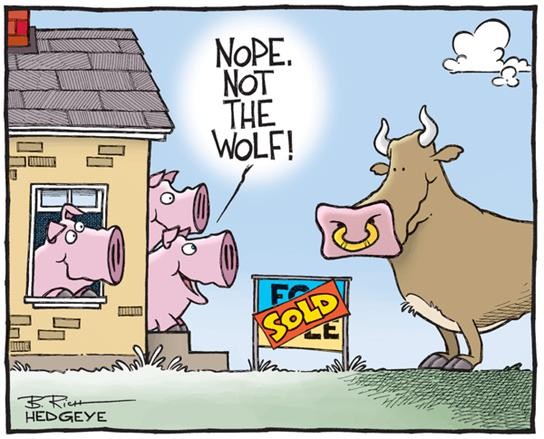
The second refuge is perhaps less obvious: US residential real estate. If history does rhyme, it offers a useful parallel: after the dot-com bust, housing replaced the Nasdaq as the engine of growth. Today the housing market is in an even deeper slump than it was then, with home sales running at levels comparable to the 2008–09 recession. Part of the reason is that the data-center boom has crowded out other construction, absorbing workers and materials, while the record wave of bond issuance by hyperscalers has also participated to push up financing costs, with 30y mortgage rates now above 7%. An AI and data-center bust would reverse these pressures, freeing up labor, lowering material costs and, more importantly, bringing interest-rate relief (thanks to recession/deflation pressures) to builders and buyers alike. Meanwhile, the structural housing shortage in the US remains unresolved: demand has not disappeared, it has simply been deferred, and it keeps building…
In football as in markets, the favorite does not always win, and the outsider written off too quickly can turn the table upside down. Don’t get me wrong, my base case remains constructive: the selling looks exhausted, technology has become the unloved outsider, and the bull market has further to run. But a good coach always has a plan B on the bench. If the correction drags on, India and US housing, two market’s segments that investors have largely given up on, could be the places to wait for better days, and perhaps even to score a few goals of their own. If not this year, likely in the years ahead. So, it might be wise to start recruiting them in your own team/portfolio.
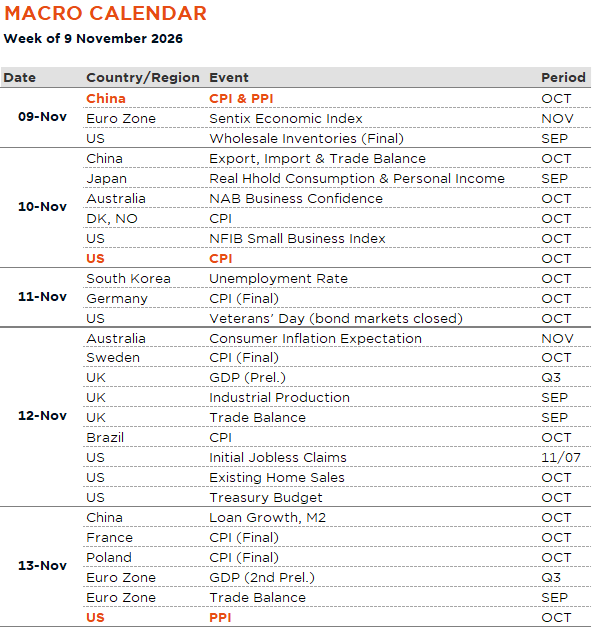
Economic calendar
Macro is likely to take a back seat once again this week. Markets should remain driven mainly by the AI narrative, the possible aftershocks of Thursday’s sharp sell-off in IT & energy and violent rotation (note that 5 sectors actually ended in positive territory last week), geopolitics, and of course energy prices.
In the meantime, last Friday US jobs report came in much stronger than expected, with beat across the board: payrolls rose by +165k (vs. +70k expected), the two-month net revision was +84k, the unemployment rate ticked down to 4.1% with increasing participation rate, and annual hourly wage growth moved back above 3%. These figures confirm that the labor market is not really part of the Fed’s current reaction function. And if it were, it would certainly not argue for a rate cut!
What about inflation, you may ask? Good timing, as US inflation will take center stage next week, with the October CPI on Tuesday and PPI on Friday. The consensus expects October’s headline and core CPI to rise moderately by +0.3% and +0.2% MoM respectively (vs. +0.6% and +0.3% the prior month). The same goes for the PPI, expected to rise by +0.4% in October vs. +1.3% in September (+0.3% vs. +0.7% for the core PPI), so monthly increases should be much more contained than last month. Plenty of other inflation figures will be released around the world, starting with China (Monday), Denmark and Norway (Tuesday), Brazil (Thursday), and the final prints for the largest euro zone economies over the week.
Staying on the monetary policy theme, and aside from economic data, there is plenty of Fed commentary scheduled throughout the week. Note also that US bond markets will be closed on Wednesday, the day after the CPI release, for Veterans’ Day.
In terms of second-tier data, several trade balances will be released and may have a more structural influence on currencies. These include China (Tuesday), whose surplus keeps swelling, the UK (Thursday), which will remain in the red, and the eurozone (Friday), now at a standstill. The UK will also publish its Q3 GDP preliminary figures.
Rounding out with corporate earnings, a much quieter week is finally ahead, with almost 90% of S&P500 members having already reported. US highlights include Berkshire Hathaway this weekend, KKR (Monday), CoreWeave (Tuesday), and Cisco and Applied Materials (Thursday). Elsewhere, names to watch include Siemens, Allianz and Softbank.
This is a marketing communication issued by DECALIA SA. It is neither directed to, nor intended for distribution or use by, any person or entity who is a citizen or resident of or located in any locality, state, country or jurisdiction where such distribution, publication, availability or use would be contrary to law or regulation. The information and data presented in this document are not to be considered as an offer or invitation to buy or sell any securities or financial instruments nor to subscribe to any services. The information, opinions, estimates, calculations etc. contained in this document reflect a judgment at the original date of publication and are subject to change without notice. Investments in any securities or financial instruments may not be suitable for all recipients and may not be available in all countries. This document has been prepared without taking account of the objectives, financial situation or needs of any particular investor. Before entering into any transaction, investors should consider the suitability of the transaction to individual circumstances and objectives. Any investment or trading or other decision should only be made by the client after a thorough reading of the relevant product term sheet, subscription agreement, information memorandum, prospectus or other offering document relating to the issue of the securities or other financial instruments. Where a document makes reference to a specific research report, the document should not be read in isolation without consulting the full research report, which may be provided upon request.