
After 38 prior proclamations that an Iran deal was imminent, a Memorandum of Understanding (MoU) has finally been signed and oil prices have slipped back below $80 per barrel since then. For sure, a MoU is not a final peace agreement. Plenty can still go wrong in the next 60 days of negotiations. Yet if the US has indeed accepted the 14 draft conditions reportedly laid out by Iran, this deal reveals just how eager the White House was to secure some form of ceasefire before the G7 summit and ahead of the July 4th celebrations marking America’s 250th anniversary. The timing could hardly have been better for another close friend of the President… Just the day before the launch of the intergalactic SpaceX rocket IPO.
So, contrary to President Trump’s portrayal of events, Iran appears as the clear winner. Fortunately for investors, markets care less about (geo)political narratives than about energy prices, inflation, economic growth and liquidity. Summer is here and the Strait of Hormuz should reopen soon. As we slip into the seasonal lethargy of July and August, a refreshing break may be exactly what markets needed. The reversal in energy prices should bring welcome headline inflation relief, while improving also growth prospects, especially in Europe and Asia. As a result, the immediate outlook therefore remains supportive with sentiment likely staying constructive over the coming months on the back of a combination of easing inflation pressures, recovering activity and another solid earnings season, which should thus allow equities to grind higher.
The more interesting question is what happens next. Because while investors have been busy celebrating lower oil prices, another risk has quietly returned to the stage: a more hawkish Federal Reserve. The latest FOMC communication was notable not for what it said, but for how little it said. Speak less, act more… The statement (available here) was shortened, simplified and concluded with a message that leaves little room for interpretation: „The Committee will deliver price stability.“
Markets may ultimately have moved too aggressively in pricing rate hikes already in July (odds have risen to around 40%), while September is now effectively fully priced in. Taken literally, a Fed genuinely committed to returning inflation to 2% would require substantially higher rates as the Taylor Rule would imply Fed Funds around 5% currently… Reality, however, is rarely that simple. For the time being, bond yields remain apparently below the pain levels that would seriously challenge equity valuations or reignite concerns over government financing costs. Equally important, the market’s dominant narrative remains intact: AI-driven capital expenditure. As long as hyperscalers continue raising investment budgets and investors continue believing that those investments will generate attractive returns, earnings revisions should remain supportive.
In the meantime, asset inflation is increasingly shaping consumer behavior, as well as corporate decision-making. Loose financial conditions and rising stock prices continue to spill over into the real economy, increasing the likelihood that inflation remains above target for a 6th consecutive year. The longer this dynamic persists, the more dependent economic activity becomes on rising asset prices. This dependence creates its own fragility.
By early autumn, investors may also need to confront several additional risks simultaneously: mid-term election uncertainty; a Fed’s rate hike; wave of equity supply as SpaceX lock-ups expire and Anthropic potentially comes to market; increasing competitive pressure from open-source AI models; or the simple reality of unfavorable seasonal patterns… Individually, none of these risks are necessarily fatal. Collectively, they could prove more challenging.
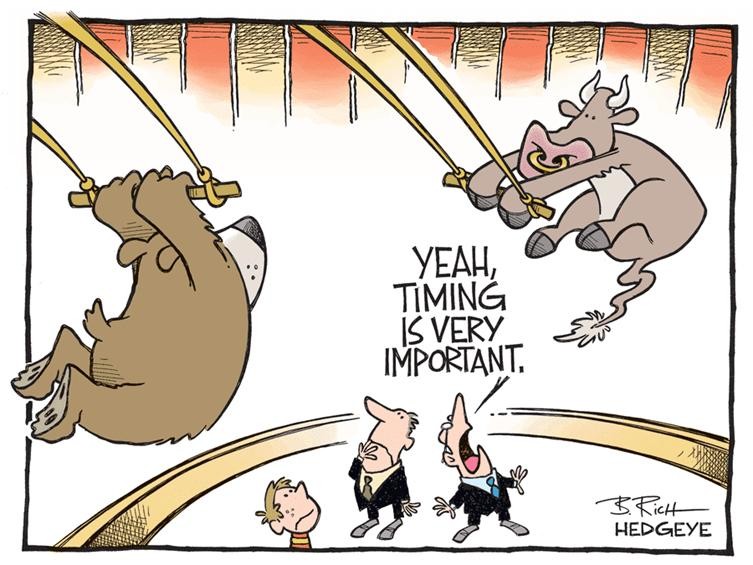
Which brings us back to timing. For now, lower oil prices, resilient earnings, improving growth indicators and still-accommodative financial conditions suggest that the path of least resistance remains higher through the summer months. But cycles do not end because investors suddenly become pessimistic. They end because liquidity conditions tighten and growth outlook deteriorates.
At some point, the Federal Reserve may decide that the party has gone on long enough. The music will slow. The punch bowl will be removed. Investors will begin questioning whether AI capex can continue growing at its current pace, whether returns justify the spending, and whether some of today’s most celebrated market darlings are perhaps not entirely immune to gravity. Even rockets eventually return to Earth. When are we going to get there? As the children in the back seat of the family car so frequently ask… The answer, for now, is probably not yet. The summer road still looks clear. But somewhere beyond the horizon, the Fed may already be preparing to whistle the end of recess.
All the best on markets for the two weeks ahead. There will be no investment letter / markets views next week as I will be in Sardinia, eventually overseeing Cagliari Calcio recruitment for the upcoming season or more likely bumping into players lounging on the beach. Normal service will thus resume on July 6th.
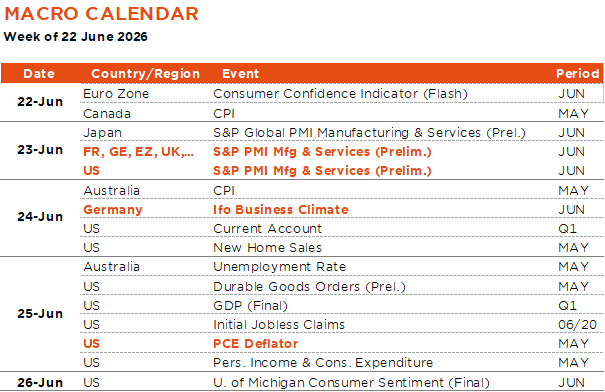
Economic Calendar
As we are slipping into the lethargy of summer, while getting close to the year’s half-time, a rehydrating break is certainly welcome… That works out well, since this week economic agenda will be light. The main highlights include the flash June PMI indices across the globe on Tuesday as well as the Fed’s preferred inflation gauge – so far-, i.e. the core PCE deflator- on Thursday.
The consensus expects the core PCE inflation to edge up from 3.3% YoY in April to 3.4% YoY in May, with a monthly gain of +0.3% MoM. The headline PCE deflator is foreseen to be up +0.5% MoM and +4.1% YoY in May (3.8% in April). Along this inflation gauge, we will get also the US personal consumption expenditures (PCE), the personal income and the saving rate. Spending should remain quite resilient (+0.2% MoM in real terms) despite the income squeeze from higher inflation, as households have continued to draw down savings. A weaker spending outcome could, however, modestly dampen rate hike expectations.
The global flash PMIs will also be amongst the (rare) data highlights this week as they will provide a first read on economic activity this month, as well as on cost pressures, across the main economies (US, Europe and Japan). In Europe, the German Ifo survey is due on Wednesday. Elsewhere, CPI reports will be released in Canada (this afternoon) and Australia (Wednesday).
This is a marketing communication issued by DECALIA SA. It is neither directed to, nor intended for distribution or use by, any person or entity who is a citizen or resident of or located in any locality, state, country or jurisdiction where such distribution, publication, availability or use would be contrary to law or regulation. The information and data presented in this document are not to be considered as an offer or invitation to buy or sell any securities or financial instruments nor to subscribe to any services. The information, opinions, estimates, calculations etc. contained in this document reflect a judgment at the original date of publication and are subject to change without notice. Investments in any securities or financial instruments may not be suitable for all recipients and may not be available in all countries. This document has been prepared without taking account of the objectives, financial situation or needs of any particular investor. Before entering into any transaction, investors should consider the suitability of the transaction to individual circumstances and objectives. Any investment or trading or other decision should only be made by the client after a thorough reading of the relevant product term sheet, subscription agreement, information memorandum, prospectus or other offering document relating to the issue of the securities or other financial instruments. Where a document makes reference to a specific research report, the document should not be read in isolation without consulting the full research report, which may be provided upon request.