
Sometimes the scoreline lies. Yesterday’s Serie A clash between Cagliari and Inter ended in a narrow, almost respectable 1-0 defeat for my beloved team. The kind of result that, taken at face value, suggests a tight, competitive affair. Dig into the underlying numbers, however, and a far less flattering picture emerges: 31 shots, 7 on target, and an expected score in the order of 4-0 in Inter’s favor…
The scoreline and the underlying process tell two very different stories, a similar read could be made looking at global equity markets, which sit near their highs. On the surface, everything looks fine. Underneath, some genuinely brave-new-world dynamics are worth watching closely. First, geopolitical risk persists, with the Strait of Hormuz still closed. Second, equity leadership has broadened in a healthy way, yet the AI trade remains an inherent source of fragility given its fast-growing importance for both financial markets and the real economy. I will come to this specific point here below. Third, and more structurally, the deterioration of public finances, and the resulting risk of higher-for-longer long-end yields (and/or currency debasement), adds a further fault line beneath the calm surface.
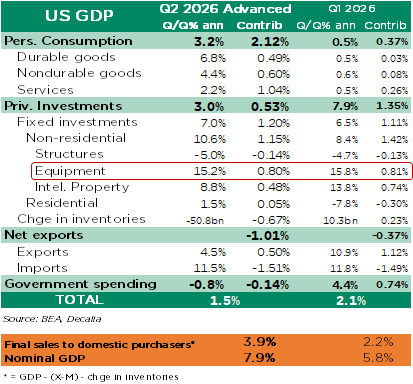
Whether artificial intelligence will ultimately live up to its promise of disrupting the economic cycle through the productivity gains it is meant to unlock remains, for now, an open question. What is far less debatable is that its near-term economic footprint is already highly visible. Equipment capex in the US is growing at an annualized rate of 15%, contributing to 0.8 percentage points to GDP growth despite “non-residential investment in equipment” representing just 5.5% of US GDP. A striking illustration of how concentrated this cycle’s growth impulse has become.
US Q2 GDP breakdown: the boom in AI capex is already visible and significant for the whole economy
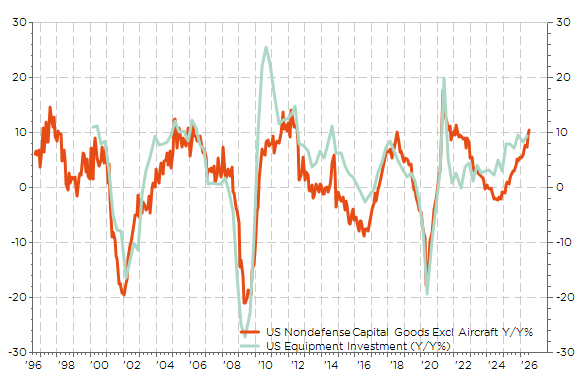
And the latest US durable goods orders report, released last week, still points to a booming US capex cycle entering into Q3. Excluding aircraft and defense components, which gives a good proxy of business capex, these capital goods orders rose +1.4% MoM in July (vs. 1.0% expected) and prior month data was revised up to +2.4% MoM from 2.0%. As a result, we may expect again a significant contribution to GDP from investment in equipment this quarter.
US non-defense capital goods orders excluding aircraft and US equipment investment (Y/Y%)
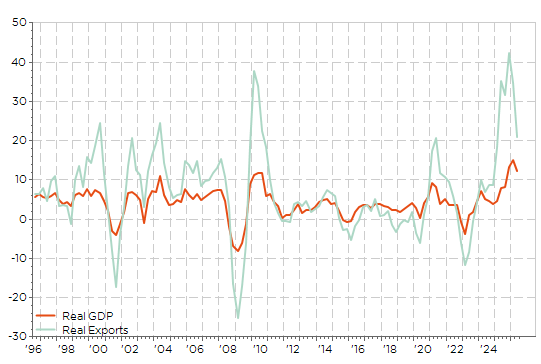
The knock-on effects extend well beyond US borders: South Korea and Taiwan, whose combined economic output of nearly $3 trillion roughly matches that of France, are seeing a genuine boom in their exports and overall activity on the back of the AI-driven hardware build-out.
Taiwan real GDP and real exports growth: boom-boom AI
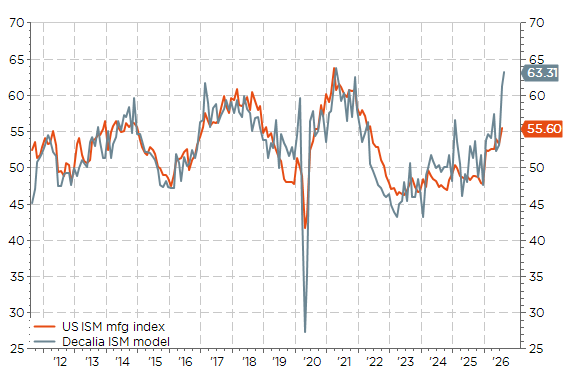
Meanwhile, the US ISM has climbed to its highest level since the post-Covid recovery, reaching readings consistent with a strong expansion or thus rarely seen outside the months that immediately follow a recession.
US ISM model: not slowing for the time being
Little wonder, then, that industrials, along with financials, now stand out as the only sectors trading at their richest valuation multiples in twenty years…
Global Sector/Factor 20Y Valuation (12M Fwd P/E)
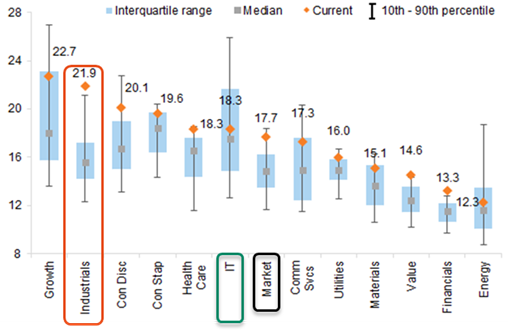
Source: Goldman Sachs
Without even mentioning the unemployment rate, which remains at historically low levels in both the US and elsewhere in DM, including the Euro Area despite the latest two to three years of anemic growth; or inflation, which has now spent 65 consecutive months above 2% in the US and has just reaccelerated in the Euro Area in August. It is worth noting in this regard that purchasing power having become a far more prominent political and media preoccupation worldwide than unemployment ever was in prior decades… So, this industrial boom, led by AI and overall infrastructure capex reads currently more like a hawkish signal rather than disinflation wishful thinking hopes for central bankers worldwide.
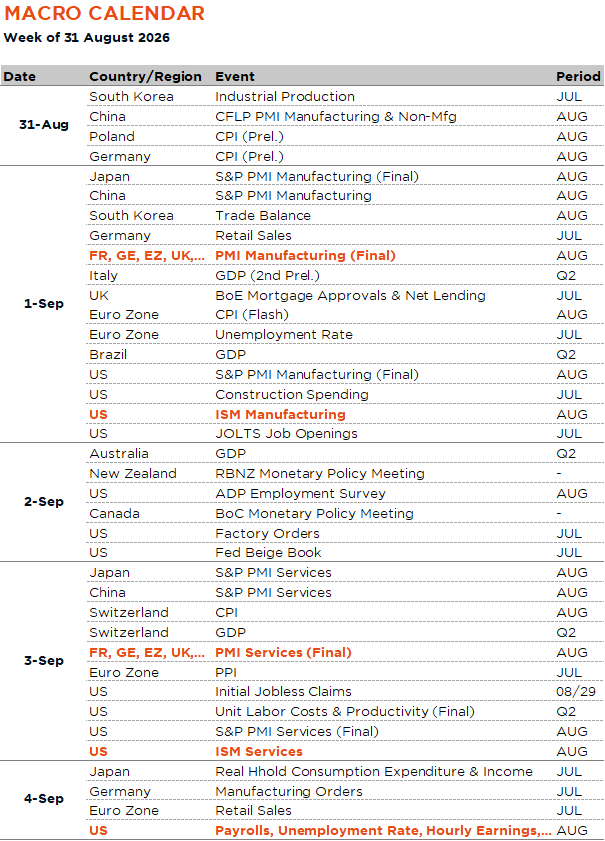
Economic Calendar
This week, all eyes will be on the US jobs report for August (Friday). After the disappointing July payrolls print (-23k and a net revision of -103k for the previous 2 months), the consensus expects some improvement with a gain of +50k in payrolls, the unemployment rate staying stable at 4.1% and average hourly earnings rising by +0.3% MoM (+0.1% in July). Before that, we will get other labor market indicators, including the July JOLTS report (Tuesday), the ADP private payrolls (Wednesday), as well as the ISM employment components. These will be published along with the ISM manufacturing and services indices, on Tuesday and Thursday respectively, which will give us a good read on US economic activity in August. The consensus expects rather stable figures, slightly above 55 for manufacturing and 54 for the services industry, while our proprietary ISM manufacturing model points towards a further acceleration, well above 60… Anyway, these figures, if confirmed, remain consistent with a robust US economic growth. Finally, the Fed will also release its Beige Book on Wednesday, providing more details on the state of the US economy.
Elsewhere, notable economic releases include:
- The final August global PMI readings for manufacturing (Tuesday) and services (Thursday) to gauge economic activity across the major economies
- Flash August CPI reading in Germany (today) and in the Eurozone (Tuesday) after the jump in similar releases for France (+0.7% MoM) and Spain (from 3.6% YoY in July to 4.3%). Swiss August CPI will be out on Thursday, along with Swiss GDP for the 2nd quarter. Staying on the European continent, German factory orders for July will be released on Friday.
- The Bank of Canada and the Reserve Bank of New Zealand will both meet and decide about their target rate on Wednesday. The former is expected to stay put at 2.25%, while the latter is widely expected to hike its target rate to 2.75% from 2.5%. On the same day, we will also get Australia Q2 GDP.
Finally, investors will keep an eye on tech earnings with the results from Palo Alto Networks and Dell (Tuesday after the close), as well as Broadcom and Snowflake (Wednesday after the close).
This is a marketing communication issued by DECALIA SA. It is neither directed to, nor intended for distribution or use by, any person or entity who is a citizen or resident of or located in any locality, state, country or jurisdiction where such distribution, publication, availability or use would be contrary to law or regulation. The information and data presented in this document are not to be considered as an offer or invitation to buy or sell any securities or financial instruments nor to subscribe to any services. The information, opinions, estimates, calculations etc. contained in this document reflect a judgment at the original date of publication and are subject to change without notice. Investments in any securities or financial instruments may not be suitable for all recipients and may not be available in all countries. This document has been prepared without taking account of the objectives, financial situation or needs of any particular investor. Before entering into any transaction, investors should consider the suitability of the transaction to individual circumstances and objectives. Any investment or trading or other decision should only be made by the client after a thorough reading of the relevant product term sheet, subscription agreement, information memorandum, prospectus or other offering document relating to the issue of the securities or other financial instruments. Where a document makes reference to a specific research report, the document should not be read in isolation without consulting the full research report, which may be provided upon request.