
This week marks one of the most anticipated days of the year. Some of us have been counting down to Thursday, when Grand Theft Auto VI finally lands in players’ hands, 13 years after its predecessor and two delays later. Others are impatiently waiting for tomorrow evening, when NVIDIA reports its first quarterly results since Jensen Huang’s resignation, and to Wednesday, when Anthropic prices what could become the largest IPO in history before its shares start trading on Thursday. I suspect there will be plenty of people more excited about one than the other, although I’m not entirely sure which side has the bigger expectations to live up to.
While Fabrizio is taking another two-week holiday, I’m back behind the wheel, and unlike in GTA, nobody had to steal the car. Hopefully, I can keep the commentary as entertaining as the markets promise to be.
But jokes aside, the parallels between these two worlds are more striking than they might initially appear: expectations are enormous, the audience is impatient, the pressure to deliver is immense, and the fan base will let you know within seconds if you disappoint. For NVIDIA, another earnings beat may no longer be enough. The market wants reassurance that the AI investment boom is sustainable, that infrastructure spending is translating into profits, and that the extraordinary growth story still has room to run. In other words, it is no longer just about delivering a blockbuster quarter. It is about living up to blockbuster expectations. So, the question is not whether they will be big, but whether they can be as big as everyone has already imagined. And that, in a nutshell, is where markets find themselves.
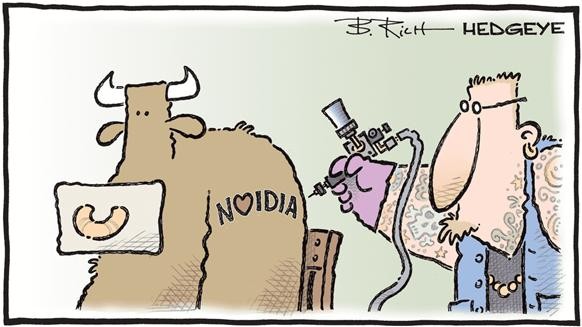
That brings us to NVIDIA, where the stakes are arguably higher than the numbers themselves suggest. Jensen Huang’s departure has sent shockwaves through the industry. In my last letter, « Silicon Valley of Debt », I worried that the AI boom might run out of financing before it ran out of demand. I did not expect it to lose its chief salesman first.
The timing could hardly have been worse. The AI trade was already having a rough autumn after NVIDIA peaked on 6 October. Then, on 5 November, just two days after the Democrats swept Congress, chip stocks suffered one of their worst sessions in years as investors worried about a less supportive Washington for data-center investment. A relief rally followed, with the Philadelphia Semiconductor Index rebounding roughly 17% in just four sessions. But the recovery was short-lived when NVIDIA’s board opened an investigation into reports that Huang had been the target of a foreign intelligence effort. Four days later, he resigned as CEO and director, with immediate effect.
To understand why the market took it so badly, you have to understand who Huang was. NVIDIA was a company built around one man: around 60 people reported directly to him. He was seen by many as its chief technologist, its chief marketer and its chief deal-maker, and, beyond NVIDIA, the AI industry’s loudest cheerleader. One analyst called him “a cheerleader for a market”; another described him as “chief strategist, dealmaker and political advocate”, with access to both Washington and Beijing. When he walked on stage in his leather jacket, he wasn’t just selling chips. He was selling the whole AI story.
Now the worries are piling up. Treasury Secretary Scott Bessent said the board should “go outside the company” and that NVIDIA needs “a dramatic shake-up”. Congress wants to question Huang in early December, and a draft rule tightening exports of advanced chips to several countries, including Singapore and Malaysia, is reportedly in its final stages. With Huang gone, the industry has lost one of its leading voices against tougher export controls. NVIDIA had also become the sector’s guarantor, with a plan unveiled in August to back more than $500bn of partners’ data-center financing with up to $125bn of guarantees. As one investor put it, “That Nvidia guarantee is not worth what it was worth a week ago.” A Wall Street Journal report on NVIDIA’s credit backstops to its own customers has also revived the question I raised last month: how much of the demand is self-financed?
So, what does this mean for the industry? In the short term, less than the share price suggests. Contracts and the product roadmap are largely locked in for the next year or two, and one analyst sees “no impact to revenue or EPS estimates through at least 2028”. But, he added, “What breaks is confidence in growth beyond that horizon.” That is exactly the problem for an industry whose valuations rest on 2027 and beyond.
And yet, the story may not be over. The FT reports that Huang has discussed a comeback with allies, two prominent investors have asked the board to keep “all options on the table”, and SpaceX CEO Elon Musk has reportedly backed a “Bring Jensen Back” letter. Prediction markets give his return small but real odds. Steve Jobs came back to Apple, after 12 years. NVIDIA’s shareholders would probably prefer something quicker.
In the meantime, interim CEO Colette Kress faces her first test on Tuesday. Analysts expect revenue of around $109bn, and the numbers will probably be fine. The difference is that, for the first time in NVIDIA’s history as a public company, there will be no Jensen on the call to turn a good quarter into a great story. The numbers will have to speak for themselves.
Two days later, Grand Theft Auto VI finally launches. In video games, when you lose your main character, you simply respawn. NVIDIA’s shareholders are about to find out whether real life offers the same option. Until next week, when we’ll hopefully be talking about $ANT’s first days as a publicly traded company.
Christophe Reuter, Portfolio Manager
Economic Calendar
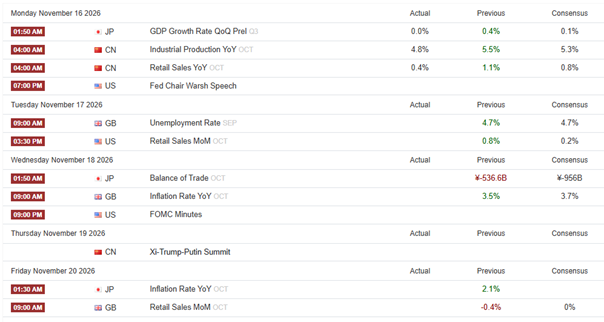
Last week was supposed to be a quieter one on the macro front. It turned out to be anything but. October’s US CPI came in hotter than expected, with headline inflation rising +0.4% MoM (vs. +0.3% expected) and core inflation +0.3% (vs. +0.2%). The surprise puts renewed pressure on the Fed, particularly after Governor Waller opened the door to a 50bps hike in December. Some economists are now even considering three additional hikes by March. Friday’s softer-than-expected PPI (+0.3% MoM vs. +0.4%) offered a slightly more encouraging signal, although one month of producer-price data is unlikely to settle the debate. In Europe, the inflation picture remains a concern too, with renewed expectations of further ECB tightening.
The focus now shifts back to the US, where this week’s releases should provide a clearer picture of the economy’s underlying strength. October retail sales and industrial production are due tomorrow, followed by the October FOMC minutes on Wednesday. The latter may already feel a little dated, as they pre-date last week’s CPI surprise. More relevant will be the 12 Fed officials scheduled to speak, including Waller and Cook, one of October’s two hawkish dissenters. Their comments should offer further insight into how seriously the Fed is considering another rate increase. Today, Chair Warsh moderates the presentation of the Fed’s task force on productivity and jobs, with AI expected to feature prominently.
Asia, meanwhile, has delivered a mixed set of economic signals. China’s October activity data disappointed across the board, with industrial production rising 4.8% YoY (vs. +5.3% expected) and retail sales just 0.4% (vs. +0.8%). Japan’s Q3 GDP stagnated, highlighting the fragility of its economic recovery.
Looking ahead, the UK publishes labor-market data tomorrow and October CPI on Wednesday, while Japan’s national CPI on Friday will be important in assessing the likelihood of a December BoJ hike. Finally, the APEC leaders’ meeting in Shenzhen on Wednesday and Thursday adds a geopolitical dimension to an already busy week.
Source: Trading Economics
This is a marketing communication issued by DECALIA SA. It is neither directed to, nor intended for distribution or use by, any person or entity who is a citizen or resident of or located in any locality, state, country or jurisdiction where such distribution, publication, availability or use would be contrary to law or regulation. The information and data presented in this document are not to be considered as an offer or invitation to buy or sell any securities or financial instruments nor to subscribe to any services. The information, opinions, estimates, calculations etc. contained in this document reflect a judgment at the original date of publication and are subject to change without notice. Investments in any securities or financial instruments may not be suitable for all recipients and may not be available in all countries. This document has been prepared without taking account of the objectives, financial situation or needs of any particular investor. Before entering into any transaction, investors should consider the suitability of the transaction to individual circumstances and objectives. Any investment or trading or other decision should only be made by the client after a thorough reading of the relevant product term sheet, subscription agreement, information memorandum, prospectus or other offering document relating to the issue of the securities or other financial instruments. Where a document makes reference to a specific research report, the document should not be read in isolation without consulting the full research report, which may be provided upon request.