
- Creating new knowledge is very different to consolidating existing knowledge
- For AI to help develop new drugs, biological mechanisms also need to better mapped
- Wet laboratory experiments thus look set to grow, not shrink, over the next few years
In financial markets, as in society at large, AI is the current buzzword. Its promises are certainly huge and its impacts on company business models already starting to materialise across a number of sectors. What of life sciences? Could AI accelerate the drug discovery process or are the days of real-world laboratory experimenting far from over?
Large language models (LLMs) – the most commonly used form of AI tools – are powerful at consolidating existing human knowledge. Trained on huge information datasets, they can perform many tasks far quicker than a human brain: provide a summary, answer questions, draft a text, write code, etc. Drug discovery, however, is a very different matter because it requires creating new knowledge, and because the underlying biological dataset is still poor.
In a recent conversation with podcast host and academic Scott Galloway, Eli Lilly CEO David Ricks estimates scientists’ current understanding of how the human body functions at only 10-20%. He goes on to describe how tirzepatide was roughly the 700th formulation of a GLP-1 receptor agonist that Eli Lilly physically developed and tested. A first version, after 200 formulations, had already been taken to human trials but failed. No less than 500 further formulations were necessary before achieving what is now commercialised as Zepbound – one of the two leading anti-obesity drugs, with worldwide sales of USD 13.5 billion in 2025.
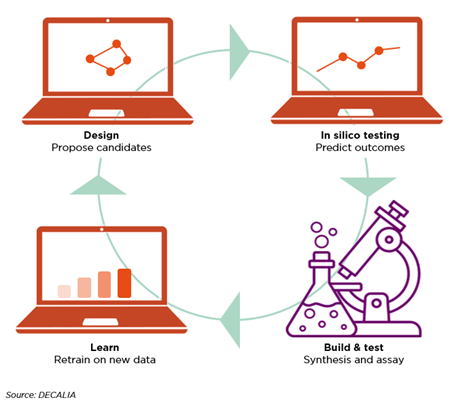
« Can we avoid those misses with AI? Not today. We don’t even know the rules of those systems » says David Ricks. Eli Lilly is thus busy working with NVIDIA to build the datasets that could teach AI models those rules. Similarly, 18 months ago, the Chan Zuckerberg Initiative (CZI) launched the Billion Cells Project. The philanthropic organisation teamed up with industry partners 10x Genomics and Ultima Genomics, as well as a group of leading researchers, “to generate an unprecedented one billion cell dataset to fuel rapid progress in AI model development in biology”. Put differently, the project aims to train AI models in biology, mapping genetic perturbations across many cell types and tissues.
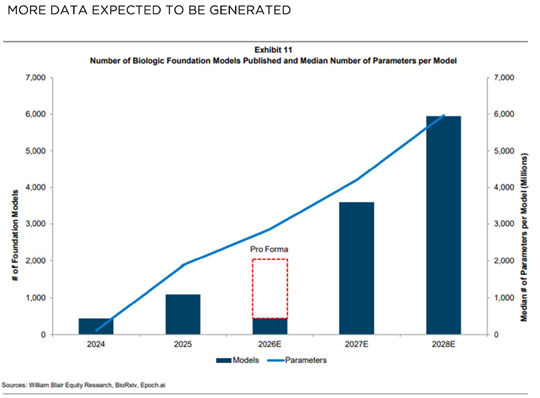
As such, and for the next few years, we expect wet laboratory experiments to grow, not shrink. Data must be generated at the bench, and confidence in future AI models build up, before part of the drug discovery process can be replaced. Pick-and-shovel companies, that enable wet lab experimentation, thus stand to be beneficiaries. Bio-Techne, which recently agreed to be acquired by Merck KGaA, for instance produces proteins, antibodies and reagents – the consumables these experiments burn through.
Thermo Fisher offers for its part the broadest end-to-end platform, providing instruments, consumables, reagents and sequencing. Danaher figures among other notable actors in the fields of bioprocessing, cell analysis, flow cytometry and microscopy, as well as laboratory automation that makes high-throughput data generation possible.
And even if, several years down the road, the number of laboratory steps is indeed reduced thanks to AI, human experimentation will remain necessary. Skipping clinical trials, with their rigorous tests, third-party review and regulatory oversight, is simply not an option. However desperate patients might be…
Iana Perova, Fund Manager
More data expected to be generated
Number of Biologic Foundation Models Published and Median Number of Parameters per Model
Houston, we have a momentum problem
- It is all about AI… and oil prices, eventually
- Warsh, peace and higher-for-longer rates
- Goldilocks denied, again
Since our last strategy meeting, two intertwined stories have dominated market headlines: AI trade unwinding and the oil price rebound. On the geopolitical side, hopes for a durable US-Iran de-escalation evaporated as bombings and the blockade of the Strait of Hormuz resumed – a reminder, as we alluded to last month, that a memorandum of understanding is not a peace deal. On the technology side, China’s Kimi K3 model showed a startlingly competitive cost-to-intelligence ratio, reviving memories of the initial DeepSeek shock and adding another concern to the past month’s AI trade unwinding. Considering also resurgent energy prices, a newly hawkish Fed under Chairman Kevin Warsh, higher real rates and choppy, range-bound equities digesting all this at once, the picture is one of a market pricing several live tail risks simultaneously rather than absorbing a single dominant shock.
Beneath market headlines, economic growth remains resilient but increasingly divergent. Manufacturing activity keeps accelerating on AI, defence and energy infrastructure spending even as services and consumption look more sluggish. The same dispersion shows up regionally: the US remain the main engine, the euro area outlook is improving but hostage to further energy price increases, and Chinese growth slipped below 5% in Q2 (its slowest pace since end-2022) with domestic demand still struggling despite ongoing government support. US inflation fortunately cooled in June, briefly dampening rate-hike expectations, though we consider this as temporary relief given the energy shock underway. The bigger story lies at the Fed: new Chairman Kevin Warsh has adopted a distinctly hawkish tone, or at least a less certain path for monetary policy, launched five new task forces, all the while reaffirming the 2% inflation target as untouchable.
Markets have been defined less by a clear directional move than by sharp rotation. Global equities remain stuck in a choppy range as investors balance Hormuz-driven oil risk, higher-for-longer rates and worries over AI investment spending (alongside competition from cheaper Chinese companies), against a still-resilient earnings season. The momentum factor has borne the brunt of the adjustment: according to Goldman Sachs, this momentum drawdown ranks among the sharpest in more than two decades, driven by crowded semiconductor positioning rather than any single fundamental trigger. The upshot has been a healthier broadening of market leadership, with healthcare and eurozone equities notably outperforming even as AI-capex darlings sell off on their earnings beats. Sentiment has softened in step (the CNN Fear & Greed Index slipped into “Fear” territory) despite the positioning froth subsiding in a fairly orderly manner. Elsewhere, long rates sit close to recent highs as the energy shock keeps central bankers on guard, gold continues to consolidate after its extended run and now faces headwinds from higher real rates and a stronger dollar, while base metals and soft commodities continue to hold up reasonably well.
Worth a specific focus is how much the AI story itself has moved this month. Kimi K3 has emerged as the latest “DeepSeek moment,” scoring close to US frontier models on capability while undercutting them sharply on price. A few days later, the listing of CXMT (a Chinese DRAM manufacturer) sent a credible signal that the DRAM pricing tailwind behind AI-linked earnings might erode faster than expected as more capacity comes online, while China’s push for memory self-sufficiency adds a geopolitical variable to AI story. A dynamic that, should it persist, points toward a long-run bearish “endgame” with capital destruction from excess AI investment.
Conviction in a sustained capex cycle is in fact eroding according to the latest BofA investment managers survey with close to 30% expecting spending cuts before year-end. As a result, tech positioning has seen its largest reduction in a decade, and the ratio of momentum-factor volatility to S&P 500 volatility has spiked to an extreme. We view this as a healthy correction of the excess leverage and crowded positioning in the AI trade, especially as we do not expect capex to be cut as soon as this year.
In conclusion, our central scenario remains a soft landing: steady but heterogeneous growth, sticky but acceptable inflation, and a slow, bumpy path back to policy normalisation in an increasingly fragmented world, with the US still the main engine even as the gap with the rest of the world narrows. Tellingly, the re-escalation in US-Iran tensions have “reduced again” the odds of such a Goldilocks outcome, leaving three key questions heading into autumn. When (if at all) will the Strait of Hormuz reopen? How will the Fed’s new, more hawkish reaction function under Warsh evolve? Will AI monetisation happen before capex slows down? None of this has been sufficient to move us off a broadly neutral, wait-and-see stance across the major asset classes.
Fabrizio Quirighetti, CIO & Head of Multi-Asset
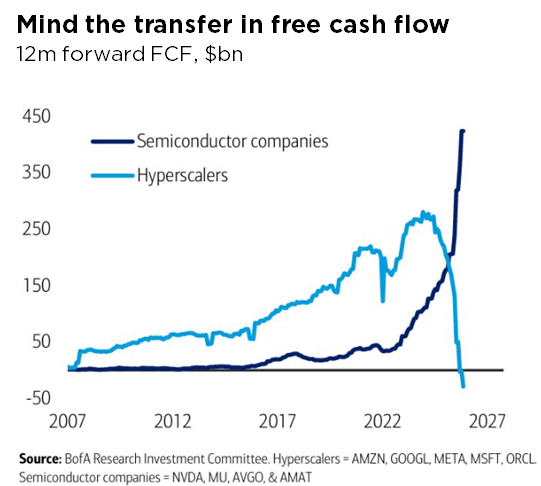
External sources include: LSEG Datastream, Bloomberg, FactSet, BofA Global Reasearch, William Blair Equity Research; bioRxiv; Epoch AI. BofA Research Investment Committee. Hyperscalers = AMZN, GOOGL, META, MSFT, ORCL. Semiconductor companies = NVDA, MU, AVGO et AMAT.