- Spoiler alert: the Swiss stock market has not an AI problem… but an index problem!
- Swiss equities offer a broad opportunity set of “picks & shovels” along the AI value chain
- Reaching out to these hidden AI gems calls for true stock picking spirits, however
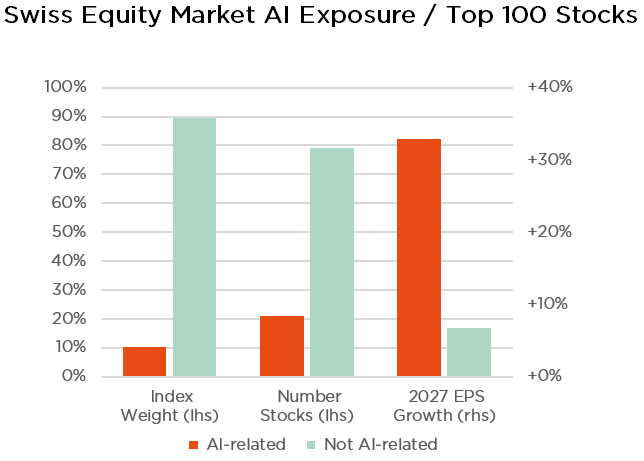
Who, in the world of finance, has ever been taught that “Switzerland is not an AI market”? Most of us, probably. The truth is, however, far more complex with the widespread confusion between a country’s equity “index” and its “market” often driving a common misconception among investors. Particularly in Switzerland, where the flagship SMI equity index is concentrated in just 20 blue chips dominated by defensive mega-caps (e.g. pharmaceuticals), that account for almost 80% of the country’s capitalisation. Whereas the broader domestic market has in fact much more to offer, with over 200 high-quality stocks diversified across multiple sectors. And the disconnect just became “worse” with the recent inclusions of Sandoz and Galderma in the SMI index, replacing non-healthcare stocks. As such, Switzerland may indeed look relatively light on AI exposure if one glances just at the SMI (below 10%), but the Swiss equity “market” actually tells a very different story beyond defensive index giants.
Admittedly, the Swiss market offers virtually no direct exposure to players in the generative AI, cloud computing, or semiconductor spaces like Nvidia, TSMC, or Microsoft do. AI is above all a supply chain though, not a sector, with its broader economy also requiring semiconductor manufacturing equipment, advanced components, sensors, connectivity, power management infrastructure, data centre equipment, software, and industrial automation just to name a few. And this is precisely where corporate Swissness comes into play, adding critical value at various levels of the upscaling but bottlenecked AI chain, and providing investors with a much broader opportunity set beyond chips. On the latter, unlike the aforementioned large US technology pure plays, Swiss equities offer a more diversified (and therefore less risky) access to the AI infrastructure investment cycle, alongside greater return resilience.
So where are these hidden Swiss “AI champions” to be found? Interestingly, not only do they span much of the global value chain, but they are also comprised primarily of small- and mid-cap equities, a long-standing pool of niche market leaders with a clear focus on industrial innovation and specialisation. Put differently, Swiss companies mostly provide the physical AI supply chain with valuable “picks & shovels” rather than the AI software and computing market segments. More specifically, within the semiconductor industry, expert companies including VAT Group, Comet, and Inficon should continue to benefit from rising manufacturing complexity and supportive hyperscaler AI capex trends. Meanwhile, with its huge amounts of electricity, cooling, power management equipment, cabling, and other physical infrastructure requirements, the AI data centre opportunity keeps driving strong growth for the likes of ABB (electrification), Belimo (thermal), Huber+Suhner (connectivity), and Accelleron (power). Finally, besides ABB, both Tecan (laboratories) and Sensirion (sensors) are also set to benefit from relentless industrial automation and robotics expansion.
How to invest in these AI gems? Considering the Swiss index construction limitations mentioned earlier, which result in notorious blind spots, the only realistic way for investors not to miss out on these names is through active portfolio strategies, i.e. direct stock picking or dedicated actively managed funds. Indeed, given the relatively small individual index weightings of these stocks, passive investment vehicles mirroring domestic benchmarks, be it the SMI, SPI, or even SPI Extra, are simply unable to meaningfully capture this fast-growing AI market segment opportunity in Switzerland.
More generally, we see Swiss equities shifting into higher gear again, backed by intact solid micro and macro fundamentals, especially in the current uncertain geopolitical environment. Hence, notwithstanding the mixed relative returns of AI-light domestic “indexes” in recent years, the Swiss equity “market” still constitutes an unmatched high-quality investment paradise for stock pickers. That said, tackling the latter with an actively managed conviction-driven diversified all-cap strategy, spanning both more defensive mega-caps and growthier cyclical small- and mid-caps, remains paramount to unlock its full potential and enjoy its long-standing multi-themed resilience.
Ultimately, one should never judge a book by its cover, nor a stock market by its index. AI is going big in Swiss equities too, providing active managers with attractive but still overlooked investment opportunities. To this end, however, Swiss investors will need for once to forego their sacred “neutrality” and dare to venture into some of the market’s blind spots…
Damien Weyermann, Lead Portfolio Manager
A fine line between credibility and sustainability
- So far, so good: growth remains remarkably resilient despite mounting headwinds
- Taking away the punch bowl… “as fast as possible, but as slowly as necessary”
- A glass ceiling with shifting floors
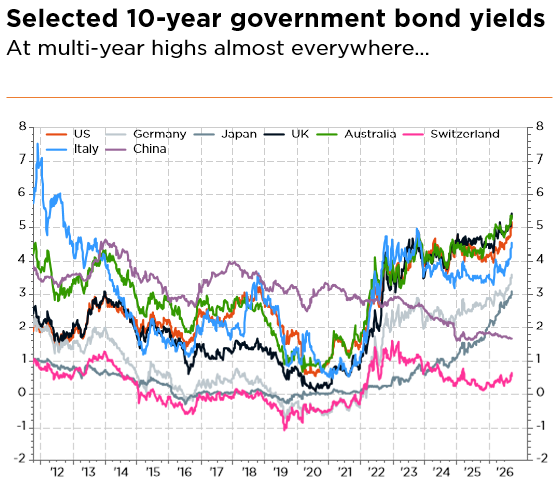
One month down the road, the backdrop tells the same story with a different, more hawkish cast. The US-Iran war is still not over, and the Strait of Hormuz remains largely closed. Combined with Ukrainian strikes on Russian energy infrastructure, this has pushed oil prices back above $USD 100/bbl and, even more painfully for Europe, lifted European gas prices towards EUR 80/MWh, with EU storage stuck at around two-thirds of capacity heading into winter. Politics have added their own share of noise. France is caught in perilous budget negotiations, while German Chancellor Merz’s CDU is under pressure following the AfD’s 45% score in Saxony-Anhalt. In the US, the mid-term campaign is kicking off, with Democrats increasingly likely to regain the House, as living costs and the conflict with Iran turn into political liabilities for the administration. Against this backdrop, markets have been walking a fine line. On one side, central banks are keen to restore their inflation-fighting credibility. On the other, bond vigilantes are increasingly questioning the sustainability of public finances, and long-term rates have been pushed to multi-year, in some cases even record, highs.
The good news is that global growth remains remarkably resilient. Forecasts are being revised up almost everywhere, manufacturing keeps expanding on the back of the AI boom, as well as defence and infrastructure spending, and services are improving, especially in developed markets. The US labour market is neither too hot nor too cold: payrolls are growing by roughly 50,000 per month, consistent with a stable unemployment rate given shrinking labour supply, and jobless claims remain historically low. Europe’s growth hopes are still intact despite the energy Damocles sword. China, meanwhile, is stuck around 4% growth: its deflating housing bubble continues to weigh on confidence, exports remain a rare bright spot, and the 15th Five-Year Plan amounts to „more of the same“ supply-side upgrading without a decisive fix to domestic demand. The less good news is that inflation is proving sticky. This leaves wide open the key question of whether inflation can recede sustainably towards 2%. Central banks have drawn their own conclusions, and an almost synchronous monetary tightening is occurring across developed markets. The Fed, the ECB and the BoJ all hiked by 25 bps last month. As far as the Fed is concerned, it confirmed its hawkish tilt unanimously, with a terse 130-word statement and a dot plot that now projects 4.1% Fed funds throughout 2027 (vs. 3.6% in June) as well as a higher-for-longer neutral rate consensus. For now, this looks more like a removal of accommodation than a genuine tightening. Still, markets are pricing in close to three further hikes by late 2027, and another move in December, if not sooner, appears likely.
In this challenging context, global equities are still hovering near all-time highs. Beneath the surface though, they face a ceiling of uncertainties made of geopolitics, energy, government debt, central banks and AI. Rotations have been rapid and violent: the Mag7 are catching up while the Russell 2000 lags, and breadth has narrowed sharply. Sentiment has soured accordingly, even though positioning and flows remain supportive. Still, the fundamental picture has rarely looked so solid. Earnings revision ratios have stayed above 1.0 for 16 straight months, trailing S&P500 EPS growth is running at 26%, and consensus now expects MSCI AC World earnings to grow by about 15% in 2027. Hyperscaler capex is headed for USD 800bn this year (double last year’s level) and close to USD 1,000bn next year. As a result, valuations keep getting cheaper, with the global 12-month forward P/E back at 16.7x and the S&P 500 now trading at 19x (expensive, but not exceptionally so). Fixed income, by contrast, has suffered rough times. Long rates have broken new highs on the back of resilient growth, higher inflation, increased supply, fiscal concerns and political gridlock expectations. The US 10-year yield is now above 5%, long-end Treasuries and Euro govies are nursing year-to-date losses, and European peripheral spreads, in France particularly, have widened.
Credit spreads have cheapened only slightly and remain pricey overall, though all-in yields have improved. Gold has lost some ground on a more hawkish and credible Fed, while the dollar is moving in the exact opposite direction.
Our central scenario remains one of steady positive growth, sticky but acceptable inflation, and a slow and bumpy rate normalisation in a fragmented world, with the bond market still adjusting to higher-for-longer policy rates. The disinflationary process is on pause because of the energy shock, with latent structural upside risks from demographics, deglobalisation and decarbonisation. Fiscal policies are still acting as a tailwind for growth and inflation, working against monetary policy and raising growing concerns about fiscal dominance in several major developed economies. The downside scenario is one of stagflation, whereby persistent core inflation forces durably tighter policy, ending up in a recession, possibly compounded by bond market instability, private credit dislocation or an unwinding of the AI trade. The upside scenario would require an improving geopolitical backdrop, faster disinflation on lower energy prices and rapid AI-driven productivity gains.
All told, we have decided to leave our tactical allocation unchanged, that is to remain broadly neutral and in wait-and-see mode, still constructively invested but cautiously diversified. In equities, resilient activity data, accelerating earnings, supportive flows, easing multiples and cleaner positioning continue to be offset by rising rates, elevated energy prices and sustained geopolitical uncertainty. Limited visibility on Hormuz, narrower breadth and ever sharper rotations also argue for patience. Diversification remains the cornerstone of our investment approach: within equities (by region, sector, style and market cap), within fixed income (across geographies, maturities, sectors and credit risks), and through uncorrelated alternative strategies or our forex exposure, which currently offer better ballast than gold or long-dated government bonds in the absence of a severe recession.
Fabrizio Quirighetti, CIO & Head of Multi-Asset