
Yesterday evening at the Unipol Domus, Juventus did everything… except win. 72% possession, 1.9 expected goals against Cagliari’s 0.5, and yet they were trailing from the 20th minute after a Daniel Maldini goal, before Randal Kolo Muani snatched the equalizer in the 81st. The Old Lady had the ball, but not control of the script.
Last week on the markets followed exactly the same script. Risk assets had possession: an earnings season shaping up well and an AI theme still dominating the narrative. But it was the geopolitical underdog that opened the scoring: the Iranian threat over the Strait of Hormuz dominated the news flow, sustaining a risk premium across energy commodities, with Brent jumping 3.9% on Thursday to above $104. As a result, inflation expectations were rekindled, tripping up AI and semiconductor stocks. Just as in Cagliari, the equalizer came late and from an individual action rather than collective build-up play: Donald Trump calmed nerves by ruling out a strike on Iran before the midterm elections, allowing oil and yields to ease slightly.
The real opponent, though, was the bond market, which played like a compact low block, making every attack costly. On October 7, the 10-year US Treasury yield climbed above 5.35%, its highest level since 2002, while the 30-year bond hit 5.70%. The drivers go well beyond a single oil spike: sticky services inflation, massive government borrowing and strong economic growth are keeping rate expectations elevated, while heavy investment in AI infrastructure, and the subsequent bond’s issuances, is adding to the demand for capital and pushing borrowing costs up globally. The pressure is not just American either: Japan’s 10-year yield has risen to a three-decade high, UK Gilt yields are at their highest since 2008, and France’s 10-year is approaching 5%. Late in the week, yields finally began to stabilize in the absence of major economic data.
Against this backdrop, the bar for a Fed hike at the end of the month now looks high. Since the FOMC’s last meeting, financial conditions have already become noticeably less accommodative, with higher yields, wider credit spreads and a stronger dollar effectively doing part of the Fed’s job. Like VAR, which only overturns the on-field call for a clear and obvious error, it would take a much hotter-than-expected CPI print on Wednesday, against a consensus of 3.6% for headline and 2.4% for core inflation, together with a continued run of upside macro surprises, to change the decision. For now, the status quo appears to have a clear lead.
The final scoreboard? Fresh records for the S&P500 and the Nasdaq, but the CAC 40 down -1.2% and the Stoxx Europe 600 virtually flat: an almost perfect draw. For markets, as for Juve, the challenge now is to turn dominance into points. The next fixtures come thick and fast: US September inflation on Wednesday, followed by quarterly results US banks (JPMorgan, Goldman Sachs, Bank of America and Citigroup among others) as well as ASML and TMSC for signals about AI capex.
Economic Calendar
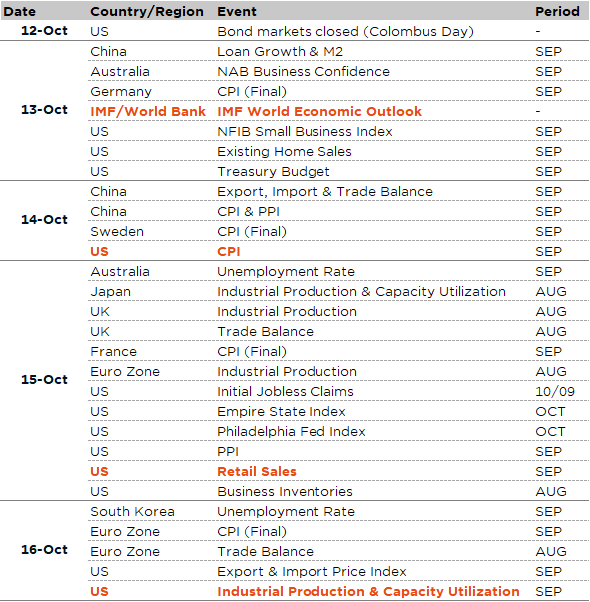
This week, all the eyes will be on the US CPI report for September (Wednesday) as well as on the earnings season kick-off. In addition, a few US activity data will also be released such as US retail sales (Thursday) and industrial production (Friday), while the IMF/World Bank meetings, including several central bankers’ speeches, will take place in Bangkok throughout the week, with Fed Chair Warsh appearance scheduled on Friday.
Ahead of the next Fed meeting at the end of this month, the most awaited economic release will be the September US CPI report on Wednesday. The consensus expects the headline CPI to increase +0.6% MoM vs. +0.4% previously, whereas the monthly increase in core CPI is foreseen at “only” +0.2% vs. +0.3% in August. On an annual basis, headline and core inflation are expected to come at +3.6% (vs. 3.4% previously) and 2.4% (2.5% last month). The PPI report (Thursday) and import prices (Friday) will also be important to get a sense of the readthrough to core PCE, which will be released later this month.
Finally, the earnings season will kick off on Tuesday with results from JPM, GS, C and WFC. The following day, it will be the turn of BofA, MS and BLK to report. Investors will also closely watch the results from ASML (Wednesday) and TSMC (Thursday) for signals about AI capex.
This is a marketing communication issued by DECALIA SA. It is neither directed to, nor intended for distribution or use by, any person or entity who is a citizen or resident of or located in any locality, state, country or jurisdiction where such distribution, publication, availability or use would be contrary to law or regulation. The information and data presented in this document are not to be considered as an offer or invitation to buy or sell any securities or financial instruments nor to subscribe to any services. The information, opinions, estimates, calculations etc. contained in this document reflect a judgment at the original date of publication and are subject to change without notice. Investments in any securities or financial instruments may not be suitable for all recipients and may not be available in all countries. This document has been prepared without taking account of the objectives, financial situation or needs of any particular investor. Before entering into any transaction, investors should consider the suitability of the transaction to individual circumstances and objectives. Any investment or trading or other decision should only be made by the client after a thorough reading of the relevant product term sheet, subscription agreement, information memorandum, prospectus or other offering document relating to the issue of the securities or other financial instruments. Where a document makes reference to a specific research report, the document should not be read in isolation without consulting the full research report, which may be provided upon request.