
- Modern warfare is no longer a matter of possessing the most “exquisite” systems
- Threats from hypersonic missiles and saturation attacks require a change in tack
- Deployment of a “high-low mix” brings investment opportunities across the missile value chain
Major US media reports are warning of a depletion of the country’s military stockpile, especially advanced defensive interceptors and long-range precision missiles, following the prolonged conflict with Iran. Ukraine, for its part, is suffering large-scale Russian aerial attacks on an almost daily basis and a lack of high-end interceptors leaves it highly vulnerable to ballistic missiles. What do these developments say about current Western defence capabilities, and the need for a change in tack?
From a technological standpoint, China and Russia have been at the forefront of hypersonic missile developments. In layman terms, the peculiarity of such missiles lies not so much in their speed, as most ballistic missiles indeed travel much faster than sound, but in the fact that they are manoeuvrable and fly at lower altitudes, making them much harder to detect and intercept than traditional ballistic missiles. The latter have meanwhile also democratised, meaning that their number has not only exploded but their precision has also greatly improved. Consider for instance that during the First Gulf War, Iraq fired less than 100 ballistic missiles (the infamous Scuds) altogether, most so imprecise that their effect proved limited. Whereas Iran is estimated to have fired some 500 missiles in just the 4 opening days of the current conflict and many hit their targets, inflicting significant damage.
To complicate matters, the proliferation of Shahed-type drones, which basically act as cheap cruise missiles, is saturating air defence capabilities and worsening the financial equation. Traditionally, the Western military philosophy has focused on “exquisite” systems, weapon quality being deemed to overpower quantity. This approach is being pressured by the new threat of saturation attacks, ranging from higher end missiles to low-cost drones, in waves that can surpass a thousand effectors per event. Relying on a small number of highly capable interceptors no longer works: not only is it impossible to compete in terms of volumes, but the extreme cost asymmetry implies that the attacker wins economically even if all its systems are successfully intercepted.
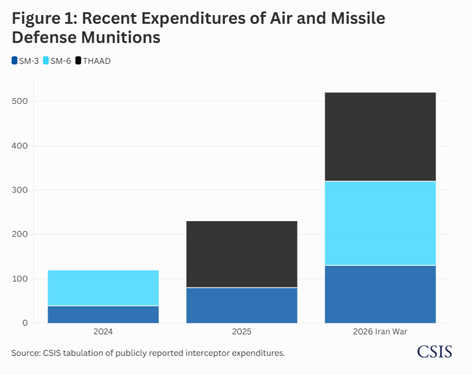
US stockpiles of high-end missiles have thus indeed dwindled, first because of the support provided to Ukraine, but above all due to the large number of stand-off attacks perpetrated against Iran using missiles such as the Tomahawk, as well as the massive consumption of Patriot- and THAAD-type interceptors used as barrage against Iranian attacks. In the wake of the “Global War on Terror”, the production of missiles was neglected, and the huge volume of systems recently deployed means that remaining stocks are almost certainly dangerously low even just considering existing conflicts. Should a confrontation against a real superpower occur, they would likely last only days.
The strategic answer lies in a deep rethinking of the defensive and offensive mix. Staying on the topic of missiles, this will imply complementing exquisite systems with a large number of cheaper systems, a doctrine known as “high-low mix”. The idea being to develop a more flexible, cost effective and scalable arsenal of effectors. To oversimplify, this means that USD 4 million Patriot PAC3 MSE missiles would be reserved for hypersonic or ballistic threats such as the Russian Kinzhal, while cheaper interceptors, be they missiles, drones or increasingly lasers, would intercept the volleys of USD 50,000 Shaheds. The Pentagon’s plan to ramp up annual production of Patriots, THAADs and other Tomahawks by a factor of 3 to 10x, while asking defence companies to develop low-cost systems, exemplifies such a strategy.
From an investor perspective, this implies a vast array of opportunities, encompassing both traditional players like L3 Harris and Northrop Grumman, very active in the “exquisite” spectrum, and new entrants in the lower-end segment, such as the Australian company EOS which is developing a fully integrated detection/interception system, using electronic, kinetic and laser solutions according to the characteristics of the threat. Interestingly, the boundaries between these segments are also blurring. Kongsberg for example, beyond its exquisite NASAMS air defence family or JSM cruise missiles, offers one of the most promising low-cost solutions in the form of the “Rusty Dagger”, a cruise missile with a price tag possibly 10 ten times lower than the Tomahawk.
Roberto Magnatantini, Lead Portfolio Manager
A market Odyssey
- A brave new world with solid grounding, but inherent fragility and persistent risks
- Receding inflation concerns, yet long-end rates keep rising
- Not a valuation bubble, perhaps an earnings one
On the surface, all looks fine with global equity indices close to highs. But our committee’s read is that this calm rests on some genuinely “brave new world” dynamics that warrant close watch. First, geopolitics risks persist with the Strait of Hormuz still closed. Second, although equity leadership has broadened, the AI trade remains an inherent source of fragility given its fast-growing importance for both financial markets and the economy. Third, the deterioration of public finances and resulting risk of higher-for-longer long-end yields add a another, more structural, fault line.
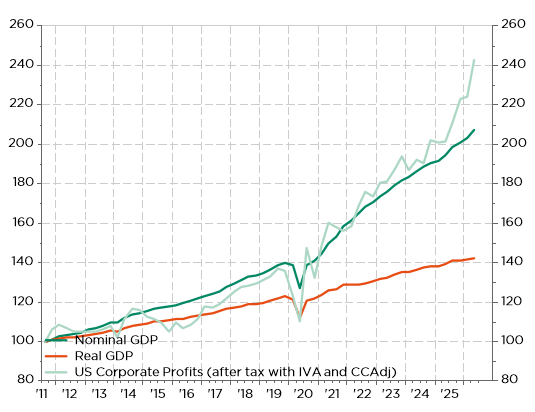
The US economy continues to do the heavy lifting globally, even though headline numbers slightly understate its strength: Q2 real GDP grew 1.5% in annual terms, with private domestic contributing the most while net trade and inventory drawdowns subtracted a combined 1.7 points. More strikingly, nominal GDP grew 7.9%, which is directly feeding into resilient corporate profit growth. Europe’s Q2 GDP growth surprised to the upside and PMIs have ticked higher, keeping hopes for a firmer recovery intact, even though an energy shock could test that story (Germany’s gas storage lags its peers heading into autumn). Chinese growth remains stuck around 4.5%, and the freshly unveiled 15th Five-Year Plan brought little new: continued doubling-down on tech and AI self-reliance on the supply side, with only half-hearted, target-free commitments to fixing chronically weak domestic consumption.
In this context, global equities have kept advancing with genuinely broadening participation, as three separate headwinds fell away almost in tandem: Hormuz-driven oil prices, still volatile but stabilising around USD 85/barrel, moved to the background, rate-hike expectations receded, at least for now, and the AI-trade unwind found both a technical and a fundamental floor, courtesy of the Situational Awareness hedge fund being absorbed without contagion and a reassuring set of Microsoft results. Above all, though, it was the overall earnings season itself that did the work, coming in extremely positive and giving the rally a real fundamental anchor rather than leaving it to sentiment alone. Currency and rate markets tell a more nuanced story: the dollar lost some ground on the back of US Treasury interventionism, first by joining Japan in supporting the yen, then by announcing that it will double its buybacks of long-dated Treasuries, as global long-term rates stayed stubbornly close to their recent highs, a reminder that bond vigilantes have not been fully placated. Elsewhere, gold rebounded strongly supported by reignited currency debasement concerns after Treasury Secretary Scott Bessent’s announcements.
The committee’s central scenario still rests on steady-positive growth, sticky-but-acceptable inflation, and a slow, bumpy path toward rate normalisation in an increasingly fragmented world. However, the sharpest edge of the discussion this month pertained not to inflation itself, which is genuinely showing signs of receding despite persistent upside risks due to the geopolitical context, but to the state of public finances and long-term bond yields. Monetary policy is „not back to normal yet,“ with several DM central banks contemplating fresh hikes rather than cuts, but the committee’s worry runs deeper than the policy rate: a fast-deteriorating fiscal picture, thus increasing the risks of fiscal dominance and in turn leading markets to require a higher term premium. It is this vicious circle dynamic – rather than stagflation alone – that now anchors the downside scenario: bond market instability and dislocation figure explicitly alongside persistent core inflation and an AI-trade unwind as the committee’s chief tail risks.
The latest BofA ML investor survey bears this out, with a „disorderly rise in bond yields“ now cited by 27% of respondents as a top concern, rising sharply month-on-month and closing in on the AI-bubble worry as the market’s dominant fear.
If there is a bubble forming in this market, the committee’s view is that it lies not in valuations, which have in fact eased, but in the sheer pace of profit growth. Consensus now expects 31% EPS growth for the MSCI AC World in 2026 and a further 14% in 2027 (driven, of course, by the IT sector but much more evenly distributed than in the past), an extraordinary run that has continued, largely unbroken, for several quarters now. Tellingly, the vast majority of the past twelve months‘ equity returns have come from those earnings upgrades rather than multiple expansion. As such, the „expensive market“ narrative does not really hold up; the more honest question is whether profit growth of this magnitude can keep compounding, not whether investors are overpaying for it. For now, the committee sees no obvious reason for it to falter abruptly: nominal GDP growth remains genuinely strong, AI capex continues to run fast, and so long as rates and geopolitics do not step in to spoil the party, the earnings engine should keep carrying its weight. Where the committee is more cautious is on the crowd now riding that engine.
None of this has been enough to move us off a broadly neutral, wait-and-see stance across the major asset classes. In fixed income, the committee stays neutral in allocation but rather underweight in duration and overweight in credit. Within equities, the preference for high-quality names continues, but the team is tactically bracing for wider market breadth, keeping selective exposure to AI names alongside thematic secular-growth plays. Notably, the committee also used the recent market rally and accompanying drop in volatility as a window to put on tactical protections, hedging part of the equity book against a pullback over the coming months.
Fabrizio Quirighetti, CIO & Head of Multi-Asset
Earnings follows nominal growth
US real & nominal GDP, and corporate profits
External sources include: LSEG Datastream, Bloomberg, FactSet, CSIS tabulation of publicly reported interceptor expenditures.