
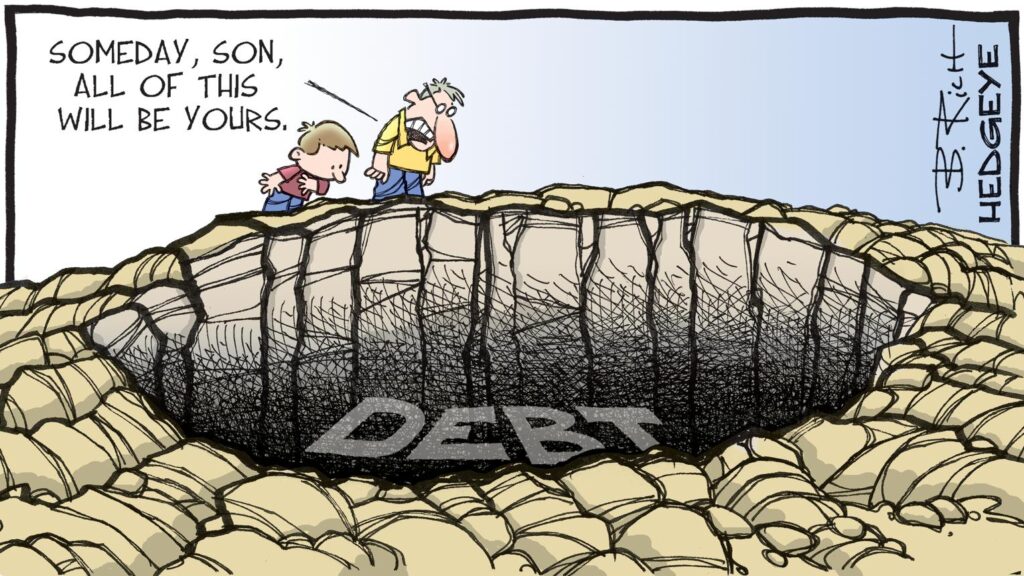
A few weeks ago, our CIO wrote that interest rates were sitting at levels younger generations have never seen. And he’s right: the US 10-year has returned to levels it last saw when I was busy learning to walk. By the time I learned about bonds, central banks had already convinced me that negative rates were a perfectly normal feature of the economy. So, when he asked me to hold the pen this week while he is on holiday (and, I suspect, somewhere near Monza tonight, where Cagliari will try to stretch their unbeaten run), I couldn’t resist a bond-market analogy. This week, you are swapping a seasoned, high-coupon issue for one that is 25 years younger: lower carry, much longer duration, and an investment-grade rating still to earn. Fortunately, the market was kind to long duration last week.
Though for a moment, it looked like the opposite. September CPI came in hot at 3.7% (consensus 3.6%), and producer prices jumped 1.3% on the month, double the consensus. The 10-year briefly spiked to 5.33%, and the odds of an October Fed hike hit 50%, before fading just as fast. By Friday, the 10-year was back below 5.1%, and the 30-year yield had fallen 17bps on the week. Yet inflation was not what moved markets most.
The bigger shock came from a different corner of the market: the growing realization that the AI boom may be running into financing constraints long before it runs out of demand.
The shift in sentiment last week was striking: since October 6, the Philadelphia Semiconductor Index had fallen for seven consecutive sessions, losing around 16%, while CoreWeave shed roughly a quarter of its market value after one of its $1.25bn bonds briefly yielded more than 15%. Investors who had spent two years pricing the AI revolution suddenly began questioning the economics behind it. Oracle, another heavy borrower funding its data-center expansion, was caught in the same storm and lost more than 9% of its market value. Across tech, the Nasdaq fell 4.5% on the week, and updates from Anthropic and OpenAI did little to calm nerves, with OpenAI’s long-term commitments, reportedly above $1tn, still at the heart of investors’ concerns.
Yet the irony is that the companies actually supplying the computing power had a stellar week. Both TSMC and ASML posted record sales and upbeat guidance. If anything, the AI economy is short of chips, not customers. GPU rental prices have risen throughout the year, according to Silicon Data, even as hyperscalers commit hundreds of billions to new capacity. AI is increasingly being deployed in the real world, from software development to the rapid emergence of AI agents, and demand continues to outpace supply.
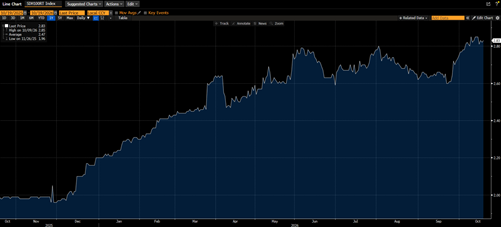
Source: Bloomberg; NVIDIA H100 Rental Index
What could derail the story is therefore not a collapse in demand, but a combination of three things: cheaper competition eroding the margins of the two leading AI labs, financing becoming harder to secure, and political opposition to data centers growing. Equity investors face a fourth risk: an earnings bubble. In AI, one company’s capex is another company’s revenue, and a growing share of that capex is funded with debt. If the spending slows, the growth already priced into AI stocks will be much harder to deliver. The market is beginning to question not the technology itself, but whether future profits can justify the investments already being made. Credit markets suggest some lenders are becoming more selective, while others are heading for the exit. The AI boom may still have room to run, but 2027 is shaping up as a make-or-break year for the sector. And investors should remember: the late stages of a bull market can be among its most profitable, right up until they aren’t.
One final word on AI. On Friday, Warsh said the transition would be “a very bumpy one”. He may have a point. For two years, everyone has worried that AI would replace junior analysts. Here, for one week, the junior replaced the CIO.
Christophe Reuter, Portfolio Manager
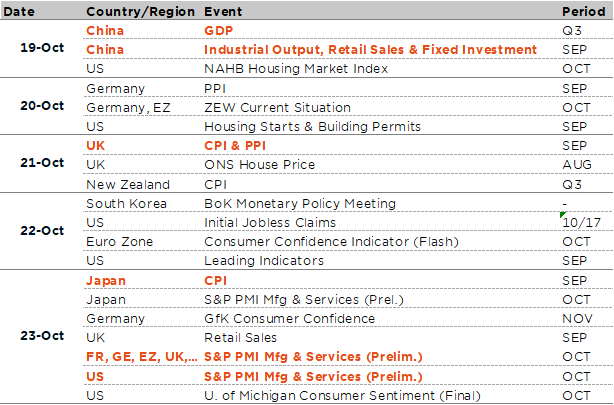
Economic Calendar
This week, inflation will remain on the spotlight with the releases of September CPI report in the UK (Wednesday) and Japan (Friday), which may convince further BoE to hike at its next meeting on November 5th (90% probability) or force the BoJ to hike by month-end (only 5% probability).
Moreover, there will also be plenty of activity data to crunch as well, starting this morning with China Q3 GDP and September retail sales, industrial production and investment. The Chinese GDP came at 4.5%, slightly above consensus expectations (4.4%), ending the month on a strong note according to September data. Quarterly performance was primarily driven by resilient export volumes and strong demand across the AI infrastructure supply chain. Retail sales surprised to the upside with +1.1% (vs +0.5% expected), while industrial production was in line with consensus (+5.5%). Property investment disappointed again (-20.6% yoy).
In addition, we will get the latest insights about manufacturing and services activity across the major economies with the global flash PMIs for this month, which will be released on Friday.
Finally, the earnings season will gain momentum with results of several mega cap tech stocks (Meta, Tesla, Netflix, Texas Instruments, IBM, Lam Research,…), but not only as some well-known “real economy” companies will also report such as GE, CSX, Dow, P&G or Honeywell, among many others.
Thank you, Fabrizio, for lending me the armband. It’s yours again next Monday, hopefully with a win in Monza and three more points for Cagliari!“
This is a marketing communication issued by DECALIA SA. It is neither directed to, nor intended for distribution or use by, any person or entity who is a citizen or resident of or located in any locality, state, country or jurisdiction where such distribution, publication, availability or use would be contrary to law or regulation. The information and data presented in this document are not to be considered as an offer or invitation to buy or sell any securities or financial instruments nor to subscribe to any services. The information, opinions, estimates, calculations etc. contained in this document reflect a judgment at the original date of publication and are subject to change without notice. Investments in any securities or financial instruments may not be suitable for all recipients and may not be available in all countries. This document has been prepared without taking account of the objectives, financial situation or needs of any particular investor. Before entering into any transaction, investors should consider the suitability of the transaction to individual circumstances and objectives. Any investment or trading or other decision should only be made by the client after a thorough reading of the relevant product term sheet, subscription agreement, information memorandum, prospectus or other offering document relating to the issue of the securities or other financial instruments. Where a document makes reference to a specific research report, the document should not be read in isolation without consulting the full research report, which may be provided upon request.