
The second-quarter US GDP print looked, at first glance, like a disappointment: growth came in at just +1.5% annualized. But headline numbers can be poor storytellers. Strip out the noise, and the US economy is not slowing… It is accelerating where it matters most.
US Q2 advanced GDP breakdown: stronger than suggested by the headline
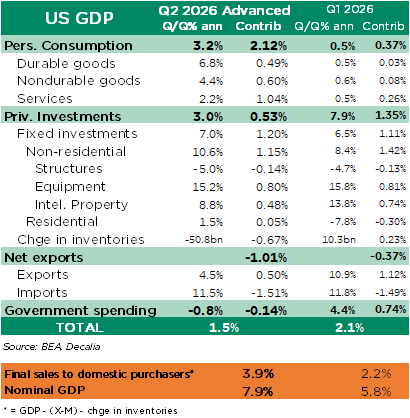
Private domestic demand is doing the heavy lifting. Household consumption rose +3.2%, and business investment jumped +7.0%. That is not the profile of an economy losing steam. It also lines up neatly with what US banks have been telling us a few weeks ago when they released their Q2 earnings: credit demand remains solid across both households and small businesses (commercial and industrial loans), and default rates are still low, with no sign yet of deterioration.
So what dragged the headline number down? Not the domestic economy, quite the opposite. Net trade subtracted 1.0 percentage point, as strong internal demand pulled in more imports, and the volatile inventories component cut a further 0.7% as businesses drew down stock (-$50.8bn) rather than restocking. Look instead at final sales to domestic purchasers – arguably a cleaner read on underlying activity – and the picture is +3.9% in real terms. That is a healthy economy, not a fragile one.
The more striking number is nominal growth: +7.9% annualized. It is a figure investors have grown unaccustomed to watching closely, but it deserves attention. Japan offers the clearest precedent for this dynamic as often underlined in past editions of this letter: since the end of the pandemic, real growth there has barely moved, while nominal growth has clearly stepped up. The US is following a similar script (less dramatically, since real growth remains a respectable ~2.5%), but the divergence between real and nominal is unmistakable.
US nominal and real GDP growth (Y/Y % change)
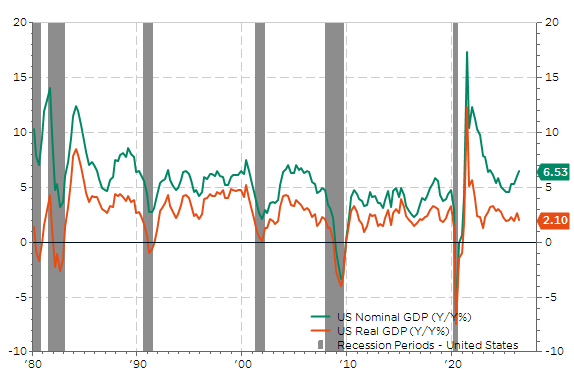
Why this matters for portfolios: the asset allocation conclusion is the same in both cases. Stronger nominal growth favors equities, whose earnings are measured in nominal terms, over bonds.
US real & nominal GDP, and US corporate profits (national income)
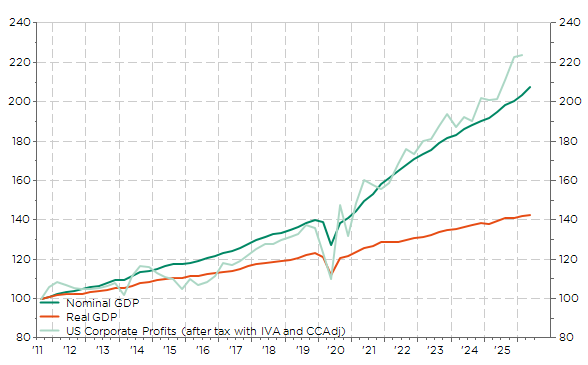
That case is reinforced by where US yields currently sit, not especially attractive, given low recession risk currently and inflation that looks more likely to stay sticky than to fade.
UST 10y rate is at fair value according to the Gundlach model
UST 10y yield = 50% US nominal GDP growth + 50% German 10y rate
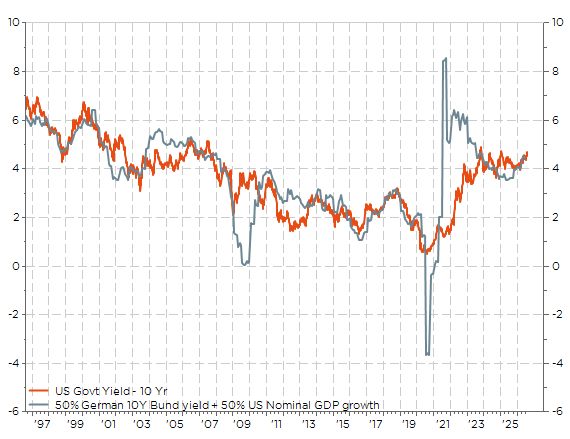
Bonds could regain their appeal relative to equities if that backdrop shifts – a change in the wind would make current valuations considerably more attractive. For now, though, the growth mix continues to tilt the scales toward equities.
Economic Calendar
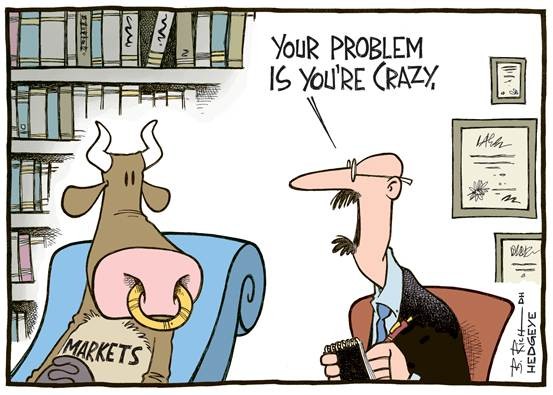
Welcome to August and back to work for the people who just swapped their sunscreen for a Bloomberg screen this morning. For the others, if you’re (still) on vacation this week, you are lucky… because you’ll certainly spare yourself another roller-coaster ride in the markets after a memorable “not for fainted-heart” week. And despite all of the actions witnessed last week/month, the S&P500 has held its ground and, somewhat remarkably, has been confined to a mere 4% range over the course of July.
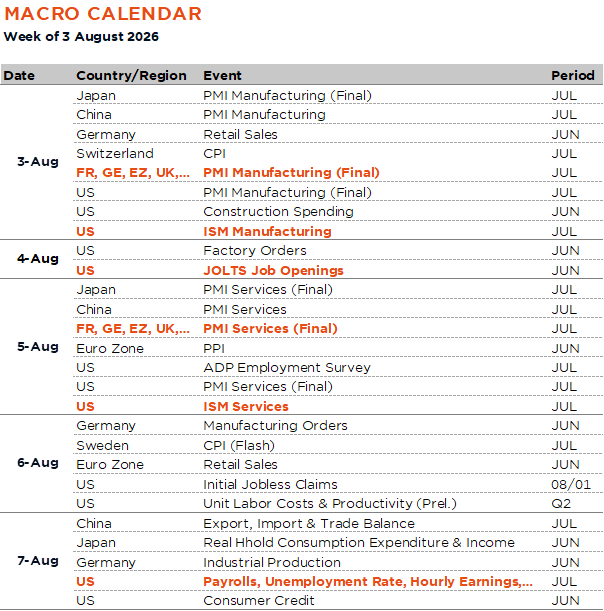
The main macro highlight of the week will be the July jobs report in the US (Friday), where the consensus expects payrolls to rise by +88k, up slightly from +57k in June, with unemployment rate remaining steady at 4.2% and the average hourly earnings to increase by +0.3% MoM and 3.5% YoY as in June. Before that we will get other labor market indicators, including the June JOLTS report on Tuesday, the ADP private payrolls on Wednesday and the jobless claims on Thursday, on top of the ISM employment components of the manufacturing and services indices for July. Basically, investors, including ourselves, expect these reports should reinforce the view that the US labor market remains resilient.
Speaking about the US ISM indices, they will be out on Monday (manufacturing) and Wednesday (services), along with the final readings of global PMI across the major economies. Overall a small improvement is expected, confirming a solid economic expansion on the both side of the Atlantic, in line with the Q2 GDP growth released for the US and Euro Area this week. I remind you that China “internal” PMI indices disappointed last Friday (PMI mfg fell below 50) and thus still indicate sluggish growth/domestic demand; whereas our US ISM model forecasts a reading above 60 in July vs. 54 expected and 53.3 observed the prior month.
Elsewhere, other economic data releases feature economic activity in Germany for June through the week (retail sales, manufacturing orders and industrial production), trade in China (Friday), as well as July inflation in Switzerland (today) and Sweden (Thursday). Finally, the Q2 season continues with another busy week ahead for corporate earnings, which will bring us the reports from SpaceX, Palantir, McDonald, Caterpillar and Eli Lilly in the US and Siemens, Rheinmetall and Novo Nordisk in Europe, or Toyota, Nintendo and Softbank in Japan, amongst others.
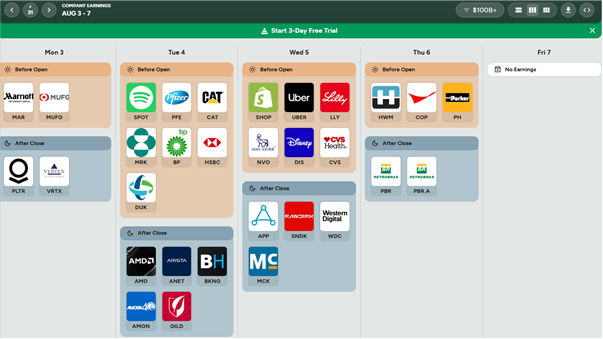
https://earningshub.com/earnings-calendar/week-of/2026-08-03
This is a marketing communication issued by DECALIA SA. It is neither directed to, nor intended for distribution or use by, any person or entity who is a citizen or resident of or located in any locality, state, country or jurisdiction where such distribution, publication, availability or use would be contrary to law or regulation. The information and data presented in this document are not to be considered as an offer or invitation to buy or sell any securities or financial instruments nor to subscribe to any services. The information, opinions, estimates, calculations etc. contained in this document reflect a judgment at the original date of publication and are subject to change without notice. Investments in any securities or financial instruments may not be suitable for all recipients and may not be available in all countries. This document has been prepared without taking account of the objectives, financial situation or needs of any particular investor. Before entering into any transaction, investors should consider the suitability of the transaction to individual circumstances and objectives. Any investment or trading or other decision should only be made by the client after a thorough reading of the relevant product term sheet, subscription agreement, information memorandum, prospectus or other offering document relating to the issue of the securities or other financial instruments. Where a document makes reference to a specific research report, the document should not be read in isolation without consulting the full research report, which may be provided upon request.