
In July 2008, the ECB raised its key rate by 25bps, arguing that inflation had become the top concern of European citizens as oil prices were spiking. Two months later, Lehman Brothers collapsed and the world plunged into its worst financial crisis since the Great Depression. The ECB and its infamous President, Jean-Claude Trichet, did it again in April and July 2011, in the middle of the European sovereign debt crisis, only to reverse course a few months later under. But, as Stranger Things fans know, things have turned upside down since COVID. Coming out of the pandemic, DM central banks made the opposite mistake. They waited too long and hiked too slowly, calling inflation “transitory” and taking the risk far too lightly. More than 5 years later, US inflation is still running above the 2% target. It is therefore only natural that central bankers now want to avoid repeating this more recent mistake.
As a result, the Fed, the ECB and the Bank of Japan each raised rates by 25 basis points this month and left the door open to more. Are we reliving 2008? Many economists think so. In their view, the wars in Iran and Ukraine are supply shocks that monetary policy cannot fix, and raising rates in the middle of an energy price shock is a policy error. They have a point. A rate hike will not reopen the Strait of Hormuz. It will not create a single extra barrel of oil, nor a single computer chip. And repeating Trichet’s mistake must be avoided at all costs. But the comparison with 2008 ends there, for at least four reasons.
First, supply shocks have become the norm in a more fragmented world, with ongoing deglobalization due to geopolitical uncertainties or new trade barriers and tariffs. That is the 65th consecutive month above the 2% target, more than five years. At this stage, the real risk is no longer the shock itself but its second-round effects… After living with high inflation for so long, households and companies start to expect it, and the expectation may thus become reality soon.
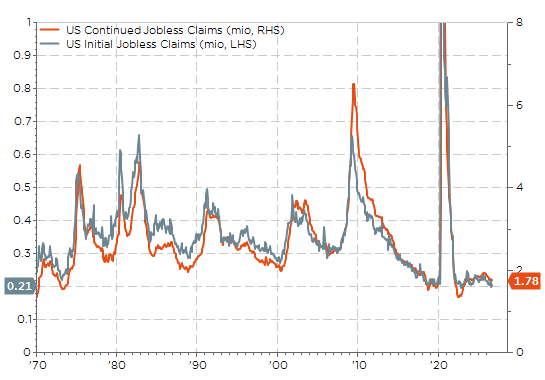
Second, demand is much stronger than expected. The supply-shock camp forgets (or eventually doesn’t see) that demand, which also sets prices, is not weakening but actually getting stronger this year. Even despite higher energy prices and yields. US unemployment fell to 4.1% in August, from 4.5% last November, well below the last 50y average of about 6%. Weekly initial jobless claims and continuing claims, a timelier and more precise gauge of the US labor market in my views, are also at multi-decade lows in absolute terms -while total working population has grown in the meantime. This robust labor market is the primary factor and key pillar supporting households consumption.
Weekly initial and continuous claims: you aren’t fired!
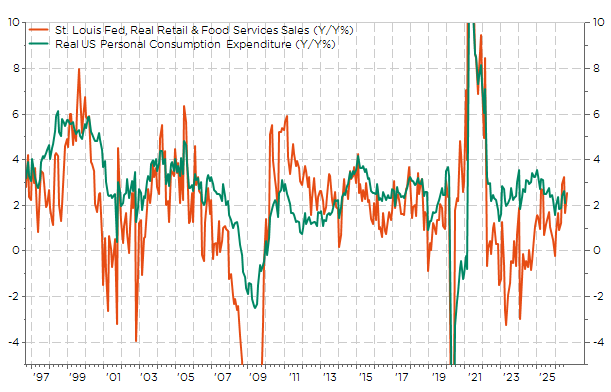
Households are indeed saving less, and spending more (of their income). US personal consumers spending is expected to increase by +0.9% MoM in August (data will be released on Wednesday), accelerating from +0.2% in July (NB: retail sales already jumped +1.2% last month).
Resilient (real) consumer spending despite higher energy costs… and rising rates
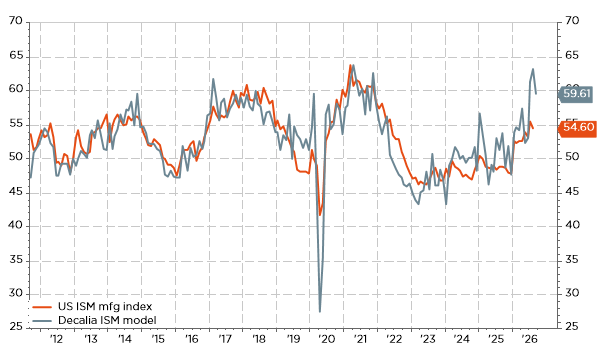
The ISM manufacturing index has been in expansion for eight consecutive months -after spending more than 3y below the 50 threshold).
US ISM mfg proprietary model: in expansion and accelerating further
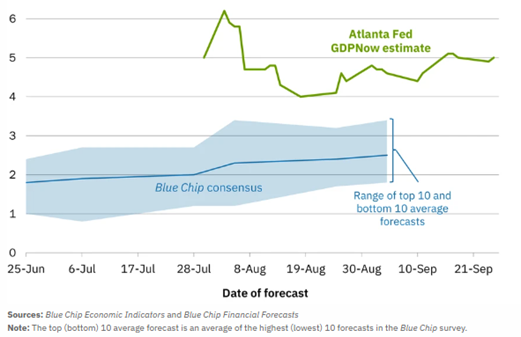
As a result, the Atlanta Fed’s GDPNow model points to 5% annualized growth in the third quarter…
Evolution of Atlanta Fed GDPNow real GDP estimate for 2026:Q3: not weakening!
Economic activity is also strong outside the US. In the Eurozone, GDP has surprised on the upside so far this year, while the August manufacturing PMI posted its strongest reading in more than four years, helped in part by higher defense spending. In Asia (excl. China), growth remains resilient on the back of the AI capex boom, and Japan real GDP growth should even accelerate next year.
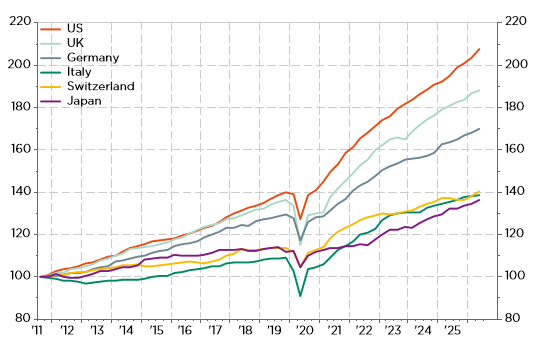
Third, nominal growth has shifted to a new regime. This is probably the most underestimated point. Since COVID, nominal growth has accelerated clearly and durably, almost everywhere. We are far from the pre-2020 world, where 2% to 4% nominal growth was the norm and near-zero rates could be justified. With nominal growth at this level, current policy rates are not restrictive. At best, they are neutral.
Nominal GDP based at 100 as of 15y ago: a faster pace everywhere since Covid-19
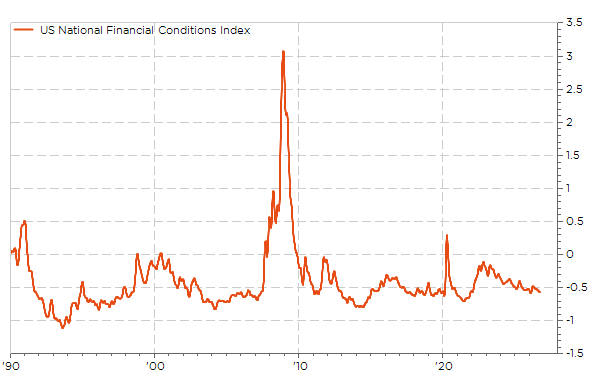
Fourth, financial conditions remain very accommodative. Remember that monetary policy works through financial conditions (including credit spreads, equity markets, forex, etc…) . And these have barely moved. The Chicago Fed’s National Financial Conditions Index stands at -0.6, firmly in accommodative territory. On the fiscal side, stimulus remains massive everywhere with budget deficit levels usually seen in recession times. In other words, fiscal policy is pressing the accelerator while central banks are barely touching the brake.
US financial conditions: rather too loose rather than tight
What does it mean for markets? Should investors worry? Not yet is the obvious answer. Historically, rate hikes become a problem for equity markets and overall risk-on assets when growth starts to falter, and that is clearly not the case today. According to the Fed’s own models, two hikes -assuming another one in October or December- would cut growth by only a few tenths of a percentage point. A solid economy can absorb higher yields as illustrated so far (it also depends of the adjustment’s speed). Risks remain, of course. Rate hikes will not solve the looming energy crisis, and rising government debt will complicate the outlook over the medium term.
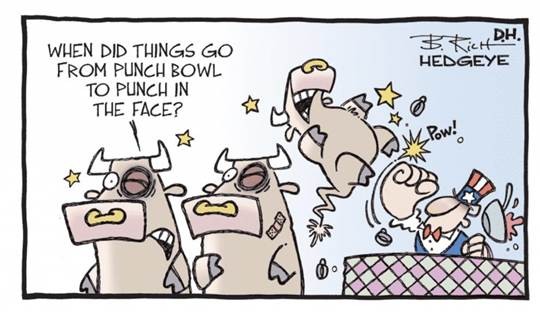
William McChesney Martin, a previous Fed Chairman in the 1950-60s, described the central bank’s job as taking away the punch bowl just as the party gets going. We are there. The economy is running at full speed, inflation is settling in, financial conditions are loose and public budgets are generous and the demand of capital for AI is huge. Waiting means risking having to hit much harder later.
This does not mean breaking the machine. The supply shock is real, and tightening too hard could turn a slowdown into a recession. The right approach fits in a phrase that our favorite politician in French-speaking Switzerland, Alain Berset, made famous at the height of the pandemic: “We must act as quickly as possible, but as slowly as necessary.” For central banks, this means tightening with determination, but in small steps, while watching closely for any sign of fatigue. This time, the mistake would not be to act. It would be to do nothing.
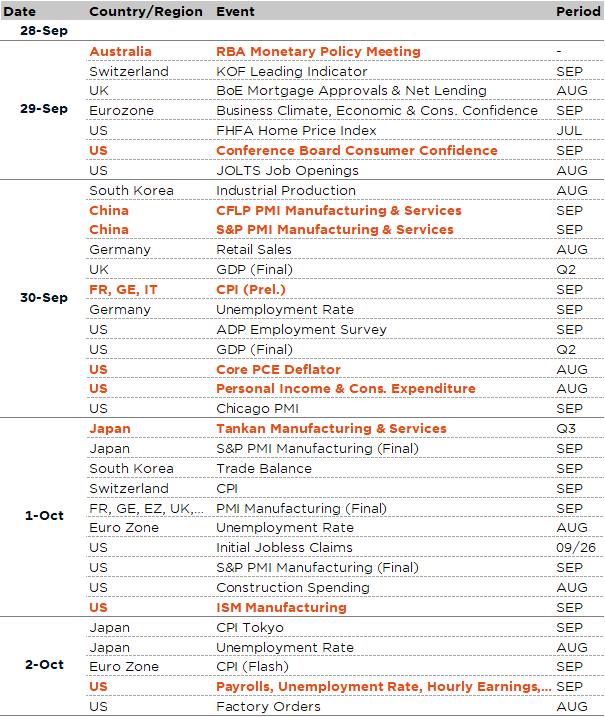
Economic Calendar
Welcome (soon) to October! We are entering the final sprint of the year with another busy week, for a change. The US jobs report for September (Friday) will be the main highlight, but there will be other key economic data releases over the week, such as US Conference Board consumer confidence (Tuesday), the US core PCE deflator (Wednesday) and the US ISM manufacturing index (Thursday).
The consensus expects payrolls to increase by +100k in September (vs. +162k in August), with both the unemployment rate (4.1%) and MoM average hourly earnings growth (+0.3%) unchanged. As usual, we will get other labor market indicators ahead of payrolls, including the August JOLTS report (Tuesday), the September ADP report (Wednesday) and weekly initial jobless claims. Barring a big surprise in payrolls (say, a deviation of plus or minus 100k) coupled with significant revisions to past figures in the same direction, this jobs report should matter less than usual, as the Fed, like other major central banks, is now clearly more focused on inflation than on the unemployment rate or activity data.
Speaking of inflation, it will remain at the forefront of global markets with the release of the US PCE deflator (Wednesday), the September flash CPIs in France, Germany and Italy (Wednesday), the September Swiss CPI (Thursday) and the Tokyo CPI (Friday). In Europe, headline inflation is expected to rise above 3% everywhere (and even approach 5% in Spain), with core inflation remaining around 2.5% (3% in Spain). The consensus sees the August US core PCE up +0.3% MoM (+3.3% YoY, unchanged vs. July). Note that US personal income and consumption expenditures for August will be released alongside the PCE deflator. Both are expected to show solid, even accelerating, gains compared to July: income +0.5% MoM (vs. +0.4% the prior month) and consumption +0.9% MoM (vs. +0.2% in July).
Other notable US economic indicators due this week include the September ISM manufacturing index on Thursday (the consensus foresees an increase to 55.0 from 54.6 in August, whereas our proprietary ISM model forecasts a higher reading of 59.6…) and the Conference Board’s consumer confidence index on Tuesday, which will gauge the current pulse of consumer sentiment. As a reminder, depressed consumer sentiment does not necessarily foreshadow weaker consumption growth, as illustrated both recently and in the past.
To conclude with Asia, where it will also be a busy week, we will get the Chinese PMIs on Wednesday morning, the BoJ’s quarterly Tankan survey on Thursday and the RBA monetary policy meeting tomorrow, where economists expect a 25bp rate hike to 4.60% in response to persistent inflationary pressures, in line with the Australian central bank’s recent comments.
The unknown unknowns from (geo)politics and energy price pirouettes will obviously continue to play a key role in day-to-day market gyrations… and investors’ headaches.
This is a marketing communication issued by DECALIA SA. It is neither directed to, nor intended for distribution or use by, any person or entity who is a citizen or resident of or located in any locality, state, country or jurisdiction where such distribution, publication, availability or use would be contrary to law or regulation. The information and data presented in this document are not to be considered as an offer or invitation to buy or sell any securities or financial instruments nor to subscribe to any services. The information, opinions, estimates, calculations etc. contained in this document reflect a judgment at the original date of publication and are subject to change without notice. Investments in any securities or financial instruments may not be suitable for all recipients and may not be available in all countries. This document has been prepared without taking account of the objectives, financial situation or needs of any particular investor. Before entering into any transaction, investors should consider the suitability of the transaction to individual circumstances and objectives. Any investment or trading or other decision should only be made by the client after a thorough reading of the relevant product term sheet, subscription agreement, information memorandum, prospectus or other offering document relating to the issue of the securities or other financial instruments. Where a document makes reference to a specific research report, the document should not be read in isolation without consulting the full research report, which may be provided upon request.