
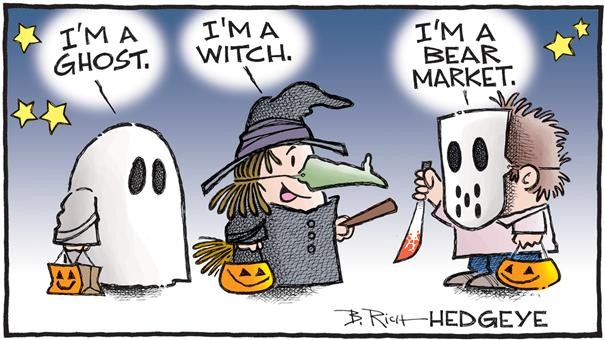
“What could go wrong?” Quite a lot of things is the short answer, starting with Cagliari Calcio. On Saturday, they suffered a 0-2 home defeat against Bologna, their second loss in a row after the 4-0 in Monza, leaving the pitch under the whistles of their own fans. To be fair, the Rossoblù seem to have an October allergy to Bologna: same score at the Unipol Domus on 29 October 2024 and again on 19 October 2025. Some horror movies clearly love sequels. So, it is easy to get scared in this Halloween season. Are you ready to scream & freak out this year too?
If not, I suggest a dark ride on the financial markets’ Ghost Train over the next few weeks. Investors are now boarding guided vehicles travelling through specially lit scenes: central banks meetings, mega-cap tech earnings, plenty of macro data, and the US midterms next Tuesday. One thing is for sure: in terms of suspense, cold sweats, devilish scenarios and potential scary surprises, investors will likely be well served. The Brazilian political scenery has already turned in a nightmare for investors as Lula won a fourth term yesterday, narrowly beating Flavio Bolsonaro. Special (headline) effects will exacerbate the uncertainties and the scary themes: the tunnel of Fed hikes, the return of living-dead inflation, the Strait of Hormuz energy crisis, or the AI capex skeletons hiding in the dark. Rapid changes of direction and sudden curves will give us a sense of disorientation, allowing themes to surprise investors when they expect them the least. The ride also features sudden ascents and descents, including iconic credit spreads.
But before screaming and freaking out in the financial Ghost Train, let’s explore the… Haunted House. Two years ago, almost to the day, I wrote a list of scary movie scripts that could derail the fairy-tale bull market, hoping they would stay in the drawer. Rereading it is a humbling exercise: some have left the drawer and are now showing in theatres. So, with the help of my younger colleague, Christophe Reuter, who hold the pen last week, here is the 2026 edition, built around the same 4 rooms: geopolitics, US politics, unfavorable macro backdrops and other endogenous or exogenous risks. As always, excluding the unknown unknowns.
Geopolitics: energy prices remain the key variable to assess the potential “lasting” economic and market impact. This time, it is not a theoretical point. In the Middle East, the script is no longer “escalation”, it is “re-escalation”. Since the US and Israel launched strikes on Iran on 28 February, the Strait of Hormuz has been largely closed to “official” tracked-in shipping, with a US naval blockade of Iran’s southern ports in place. Last week, Iran said seven tankers were hit in the strait, the largest single-day toll since the war started, and warned of a wider response. Analysts see a US attack before the 3 November midterms as unlikely, but the rhetoric on both sides has raised fears of renewed hostilities. The horror version: open war resuming after the vote, with Gulf energy infrastructure and the Red Sea route hit at the same time. And a cross-over plot: Tehran has threatened US-linked cables, data centers and AI facilities in the UAE…
US politics: control of Congress is at stake on 3 November, with potential implications for Trump’s policy agenda and financial markets. Democrats are favored to regain the House, while the Senate is a much tougher call. The outcomes we see as most disruptive are:
- A very tight result, with recounts, legal challenges and days of uncertainty over who controls one or both chambers.
- Or a result markets are not really prepared for, in either direction: Republicans keeping both chambers (a revived Trump and more fiscal room at a time of 5% Treasury yields) or a Democratic sweep (gridlock, budget and tariff confrontations with the White House).
Unfavorable macro backdrops, some of them a consequence of the risks above or below:
- Stagflation. The Fed raised rates in September for the first time since 2023 and is widely expected to pause on Wednesday, but futures price more than 80% probability of a hike in December, and the September PCE inflation will likely remain well above 3% for both core and headline. The script: a Fed forced to keep hiking into an oil shock while growth slows.
- Recession: expensive oil and higher rates finally biting. For now, the IMF still sees world growth at 3.1% in 2026, but things could turn rapidly especially if credit market cracks.
- No landing: US labor market getting too hot again, pushing the Fed under Kevin Warsh into a more aggressive hiking cycle than priced.
Other endogenous or exogenous risks include
- AI obviously as a harsh dose of skepticism has been injected into the AI narrative lately with growing uncertainty about the path and sequence of the AI buildout remaining highly dependent on power capacity and capital availability. In this regard, the IMF ranked an AI correction among the three main risks to global financial stability, counting $650bn of debt in circular AI deals. The script: a financing accident (a data centre developer unable to refinance, a hyperscaler disappointing on capex returns, or spending…) triggering a fast deflation of US market concentration.
- Bond vigilantes, who have already saddled up. The US 10y yield stands at 5.0%, as well as the French 10y yield in Europe, a more than two-decade high, with the OAT-Bund spread at about 150 bps (its highest since the euro crisis). The script: a disorderly move in Treasuries or OATs forcing central banks’ hand, with French politics adding fuel as the 2027 presidential race is already in everyone’s mind.
- A destabilising “accident” in markets: excessive and undetected leverage of a major player (private credit, real estate, insurance, bank), a big ETF blowing up, a crypto scandal. Food for thought: in the IMF’s adverse stress test, banks with 22% of global banking assets would fall below requirements, against 18% a year ago, while hedge funds now manage about $13 trillion.
- Human singularity sooner than expected. If the AI bubble does not burst, perhaps the machines will take over instead. Hard to say which one is scarier.
- Or any black swans you may think about, or other unknown unknowns.
Still, it may be valuable to hedge your back for the next few weeks with all these unknown variables creeping into the equation. Looking at “surprisingly good” market performances this year, it’s hard to distinguish between resilience or complacency given the many unexpected headwinds they had to face so far this year. Even if beneath the surface, you will find plenty of cracks, violent rotations and nasty damages to specific areas. In this context, it could be wise swimming a bit closer to the shore right now. As the saying goes, it is better to look ahead and prepare than to look back and regret. Enjoy the ride, and Happy Halloween!
This edition by Fabrizio Quirighetti, CIO & Head of Multi-Asset
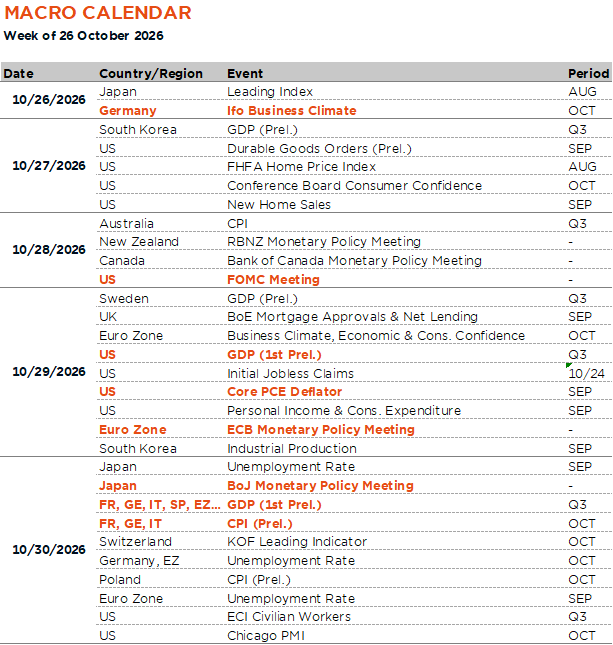
Economic Calendar
As you have probably noticed, we are currently experiencing some turbulence. Please return to your seats and keep your seatbelts securely fastened. The use of the lavatories is suspended until further notice… And volatility and nervousness are unlikely to ease anytime soon, given the busy two weeks ahead: a packed macro agenda, the bulk of the earnings season and the US midterm elections.
Central bank meetings, inflation data and the first estimates of Q3 GDP will be among the key macro themes this week. Starting with monetary policy, decisions are due from the Fed (Wednesday), the ECB (Thursday) and the BoJ (Friday), among others. None is expected to hike, but their statements and press conferences will be closely scrutinized for clues on their reaction functions and the future path of monetary policy. Moving to inflation, we will get the US PCE deflator for September (Thursday), flash October CPI for France, Italy and Germany (Friday), as well as October Tokyo CPI (also Friday). The consensus expects both headline and core US PCE to accelerate, at +0.5% and +0.3% MoM respectively in September vs. +0.3% and +0.2% in August, which would keep both indices above 3% YoY. In the euro area, Friday’s flash October CPIs are expected at 3.0% in Germany, 3.6% in France and 4.6% in Italy…
We will also get the preliminary estimates of Q3 GDP for the US and Europe this week. The consensus sees US real growth at +3.3% annualized in Q3 (vs. +2.2% in Q2), against “only” +0.1% QoQ (non-annualized) for Germany and France, and +0.2% for the euro area as a whole.
Other notable indicators include the German Ifo (released this morning, slightly above expectations with a marginal increase); US durable goods orders for September and the October Conference Board consumer confidence (Tuesday); Australia Q3 CPI and the RBNZ and BoC monetary policy meetings (Wednesday); the euro area business climate indicator and US personal income, spending and saving rate for September (Thursday); and the Swiss KOF leading indicator (Friday).
The week ahead is also packed with political events. Today, investors will digest Lula’s comeback victory over Flávio Bolsonaro in yesterday’s presidential runoff in Brazil, after trailing in the first round. Israel then holds legislative elections on Tuesday, followed by the UK Autumn Budget on Wednesday. Meanwhile, the Chinese Communist Party’s Central Committee plenum will run throughout the week, and G20 foreign ministers will meet in Atlanta at the end of the week.
Last but not least, it is also a big week for earnings, with Alphabet, Microsoft and Amazon offering a key read on AI capex. Many other tech companies will report too, such as SK Hynix, Samsung Electronics and Intel. Non-tech US mega-cap highlights include Eli Lilly, ExxonMobil, Chevron, Visa, Mastercard, Coca-Cola, Ford and Caterpillar. In Europe, we will get Q3 results from Novartis, AstraZeneca, Sanofi, TotalEnergies, BP and Volkswagen, among many others.
This is a marketing communication issued by DECALIA SA. It is neither directed to, nor intended for distribution or use by, any person or entity who is a citizen or resident of or located in any locality, state, country or jurisdiction where such distribution, publication, availability or use would be contrary to law or regulation. The information and data presented in this document are not to be considered as an offer or invitation to buy or sell any securities or financial instruments nor to subscribe to any services. The information, opinions, estimates, calculations etc. contained in this document reflect a judgment at the original date of publication and are subject to change without notice. Investments in any securities or financial instruments may not be suitable for all recipients and may not be available in all countries. This document has been prepared without taking account of the objectives, financial situation or needs of any particular investor. Before entering into any transaction, investors should consider the suitability of the transaction to individual circumstances and objectives. Any investment or trading or other decision should only be made by the client after a thorough reading of the relevant product term sheet, subscription agreement, information memorandum, prospectus or other offering document relating to the issue of the securities or other financial instruments. Where a document makes reference to a specific research report, the document should not be read in isolation without consulting the full research report, which may be provided upon request.