
Three weeks ago, in Beware of Certainties (27 July), we flagged how hard it had become to hold tactical convictions on rates, with investors pricing in two Fed hikes before year-end on the back of persistent inflation concerns with hardly anyone contemplating a hard landing. Since then, the data flow has told a more nuanced story on both growth and inflation – even if the bond market, so far, begs to disagree.
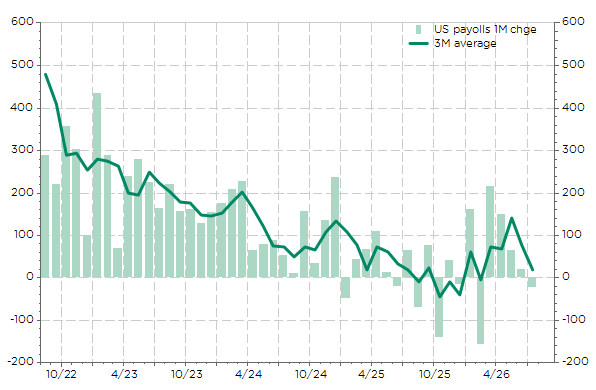
Three releases did the damage. July payrolls fell by 23k, a notable miss versus the roughly 80k gain economists expected, with the unemployment rate ticking down to 4.1% only because fewer people were looking for work, and with the prior two months revised down by a combined 103k. July CPI came in exactly in line and, for once, reassuring: headline +0.1% month-on-month / +3.4% year-on-year, core +0.2% MoM / +2.5% YoY, both a tenth of a point below June’s already-soft readings. And July retail sales fell 0.6% against expectations for a modest gain, the first monthly decline in nine months, with the underlying « control group » down 0.4%.
US 1M payrolls change and 3M average: not too hot, getting colder actually
The read-through for Fed pricing has been mechanical, and in our view entirely logical: the roughly two hikes priced in late July for the remaining year have shrunk to about one, with futures now implying a policy rate near 4% by December (barely a quarter point above the current 3.75% target rate) down from bets on a near-coin-flip September move just a couple of weeks ago. Should this moderate growth trend, coupled with further disinflation points, continues over the coming months, it is entirely plausible that the Fed ends up delivering no hike at all this year.
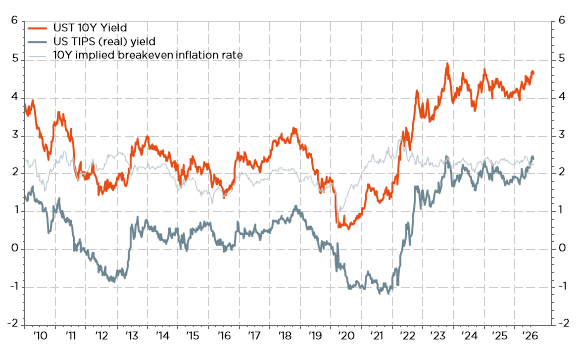
And yet the 10-year has barely moved. At around 4.7%, it sits within a whisker of the 19-month high touched just this week, essentially unchanged from where it stood when we last wrote… even after some disappointments on the growth side and a reassuring CPI. That divergence is itself the story.
We see several forces keeping term rates anchored high. The Middle East conflict remains unresolved and the Strait of Hormuz is, for practical purposes, still closed to commercial shipping, keeping an energy-driven inflation risk alive. Monetary policy itself has become a source of uncertainty rather than reassurance, with a Fed under a new Chair who has openly downplayed forward guidance, leaving markets guessing meeting to meeting. Doubts about the sustainability of public finances persist in the background: the Treasury has just sold 10-year and 30-year debt at the highest financing costs since 2007 and 2001 respectively, with the debt-ceiling question looming again depending on how November’s mid-terms play out. And yields keep rising across the rest of the developed world, Japan foremost – the 10-year JGB now trades near multi-decade highs at 2.9%, and Japan remains the largest foreign holder of Treasuries, at north of $1.2 trillion (a repatriation which, whenever it comes in earnest, would happen at Treasuries’ expense by adding additional upward pressures on US financing costs).
The clearest evidence of all this sits in real rates. The US 10-year TIPS yield, at around 2.4%, is essentially back at its highest level since the depths of the 2008 financial crisis, even as headline and core inflation, as well as inflation breakeven, gradually drift back toward more acceptable levels (still a risk, but no longer the dominant one). In other words, investors keep demanding a higher term premium than in the past, consistent with a « higher for longer » regime that, in our view, only a recession could genuinely dislodge.
UST 10y nominal and real yield: not decreasing (yet?)
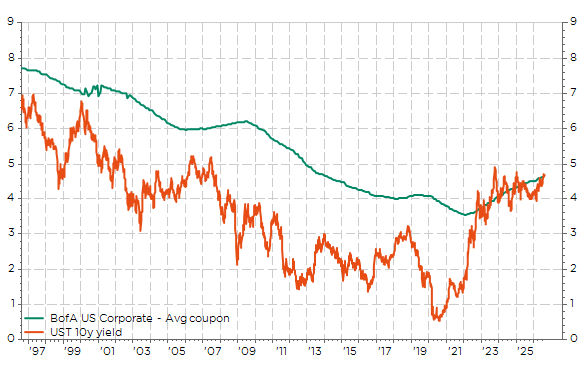
One last point, and perhaps the most striking of all: for the first time since I started managing bond portfolios in the early 2000s, the US government is now borrowing at a rate above the average coupon on the entire outstanding stock of investment-grade corporate debt, a legacy of the ultra-low-rate of the previous decade, when global companies issued massive amount of debt by extending the maturities… Think twice: we are speaking about a stock in excess of $7.5tn US IG corporate debt within the Bloomberg US Corporate Bond Index with an average coupon of 4.61 and an average maturity slightly over 10y. And most of the “low coupon/long maturity” bonds were issued in 2020-2021.
Unusual fact: the US Treasury faces now a higher financing costs today than the one prevailing on the existing corporate debt stock
For sure, companies issuing today naturally still pay a credit spread on top of the perceived “risk-free” rate, but that spread is likely to stay historically tight for a while yet… Unless a recession, or a genuine market accident, put inflation risk or fiscal-slippage concerns on the back burner at some point. At least temporarily.
Put together, these pieces argue for staying positioned in credit rather than duration within fixed income and, within credit, favoring the belly of the curve in particular, while remaining selective given how compressed spreads already are. At current term-premium levels, duration still looks like the wrong instrument to express a soft-landing view; it would only truly earn its keep in the event of a genuine recession, which remains, for now, our downside rather than our central scenario.
Economic Calendar
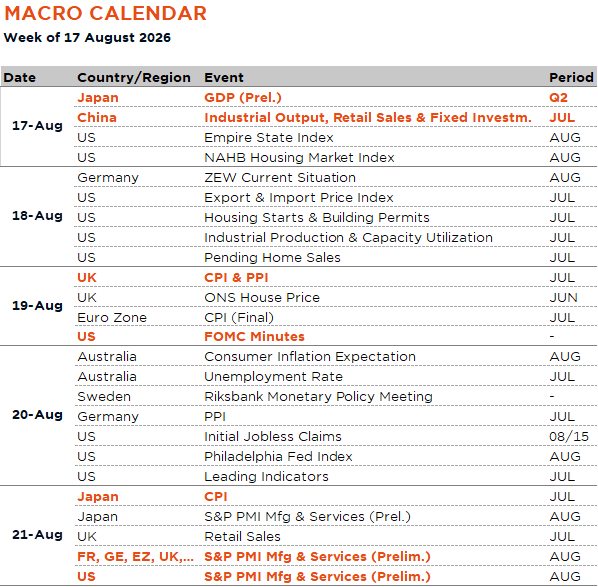
A rather light schedule for the back-to-school week here in Geneva. Global growth will be in focus with the August flash PMI indices for the major economies due next Friday. For the DM economies overall, the consensus expects the manufacturing indices to remain high / pick up, and the services one to decline slightly but still remaining above 50 (signaling an expansion of the economic activity).
Staying with economic growth, we also got the first estimate of Japan Q2 GDP yesterday (+1.1% Q/Q% annualized rate), which was disappointing as it came below expectations (+2.0%) with both consumer expenditures and capex softer than expected. Same for China July activity: retail sales, industrial production and fixed investment, they all came slightly below expectations, which were already set lower after a string of disappointing releases recently. So, the only bright spot remains undoubtedly the exports sector… China’s auto factories are building so many cars for export that the global shipping industry can’t keep up, according to Goldman Sachs.
In the US, other activity indicators will include industrial production on Tuesday (+0.3% expected in July after +0.1% in June), as well as July housing starts and building permits due the same day, or the regional manufacturing indices for August, Empire (Monday) and Philadelphia (Thursday) providing giving the first insights on current activity in this sector.
Moving to inflation, we will get UK and Japan July CPI on Wednesday and Friday, respectively. In the UK, a re-acceleration in headline inflation is foreseen (+0.3% MoM, pushing the annual rate of change to 2.9% in July from 2.6%), while the core inflation is expected to tick down to 2.5% from 2.6%. As far as Japan is concerned, both headline and core inflation are expected to rebound in July towards the 2% target, after several months of disinflation. Finally, from central banks, the FOMC minutes are due Wednesday and the Riksbank meets on Thursday (hold at 1.75%). Rounding out with corporate earnings, the spotlight will be on the US retailers this week: Home Depot (Tuesday), Target, TJX (Wednesday) and Walmart (Thursday) to gauge consumer health -which was quite strong in Q2 according to GDP figures-. Other names to watch include Alibaba and Baidu in China.
This is a marketing communication issued by DECALIA SA. It is neither directed to, nor intended for distribution or use by, any person or entity who is a citizen or resident of or located in any locality, state, country or jurisdiction where such distribution, publication, availability or use would be contrary to law or regulation. The information and data presented in this document are not to be considered as an offer or invitation to buy or sell any securities or financial instruments nor to subscribe to any services. The information, opinions, estimates, calculations etc. contained in this document reflect a judgment at the original date of publication and are subject to change without notice. Investments in any securities or financial instruments may not be suitable for all recipients and may not be available in all countries. This document has been prepared without taking account of the objectives, financial situation or needs of any particular investor. Before entering into any transaction, investors should consider the suitability of the transaction to individual circumstances and objectives. Any investment or trading or other decision should only be made by the client after a thorough reading of the relevant product term sheet, subscription agreement, information memorandum, prospectus or other offering document relating to the issue of the securities or other financial instruments. Where a document makes reference to a specific research report, the document should not be read in isolation without consulting the full research report, which may be provided upon request.