
Momentum has turned for the worse. Indeed, Cagliari lost again yesterday, this time to Lazio (2-1). Four defeats in a row. At this stage, the Rossoblù are not going through a bad patch; they are publishing a bad season in monthly instalments. Playing reasonably well and still losing is a frustrating experience, and one that some of the market’s biggest names now know rather well…
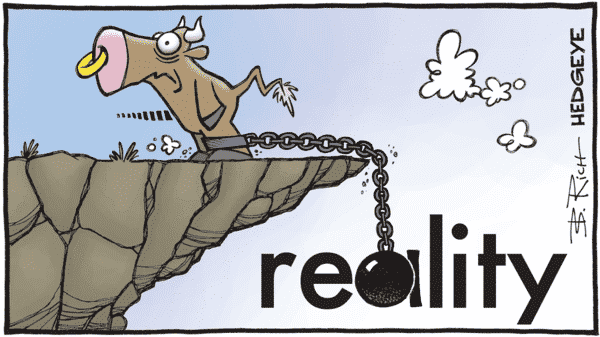
Last week, several tech heavyweights delivered good results, in line with expectations, perfectly respectable. And their shares sank anyway. The problem is not growth, which continues to be extraordinary strong. The problem is that… it is no longer accelerating! And for a market priced for continuous acceleration, “strong” has likely become the new “disappointing”. AI investment will keep growing, but the growth rate of AI capex looks to be peaking: unlike previous quarters, nobody so far revised spending plans for the coming months upwards. The music slows down a little, and everyone is rushing for a chair.
That this was enough to shake the market says a lot about how far AI debate has taken over the conversation. Because there is no shortage of material for grey hair elsewhere: the US-Iran conflict, EU natural gas skyrocketing above EUR 100/MWh, the incoming US mid-terms, the election shock in Brazil or uncertainty in Israel, budget battles in Paris and London. Any one of these would normally make the front page. Today they are footnotes to a hyperscaler’s capex guidance. Uncomfortable as it is, the market is not entirely wrong to look at things this way: the AI investment cycle remains the largest driver in macro markets, and whatever the coming newsflow brings will still play out mostly through micro themes in equities.
And this AI obsession has had at least one welcome side effect. As money moved away from the AI winners, market breadth finally improved, through a simultaneous “catch-up” and “catch-down”. The S&P500 index is down -1% last month, while the S&P500 equal-weight is up +5%. Not the most elegant way to fix a narrow market, but it works. Whether the rest of the market can keep climbing will now depend largely on energy prices and interest rates, which brings us back to that long list of worries.
Many of them will come to a head in the next few weeks, which could mark peak event risk: mid-terms, jobs report, Iran headlines, CPI and energy prices. Once that wall is cleared, the stage looks set for a year-end rally, likely led once again by the tech mega-caps, as the AI sentiment pendulum may have swung too far given the still-impressive results overall and thus the subsequent derating.
Until then, what do we do? Not much, and on purpose. Across bonds, equities and even gold, it seems wiser to wait for better visibility before adding additional exposure or reshuffling the cards for 2027. After all, unlike Cagliari, we are not obliged to take the field every Sunday.
Economic Calendar
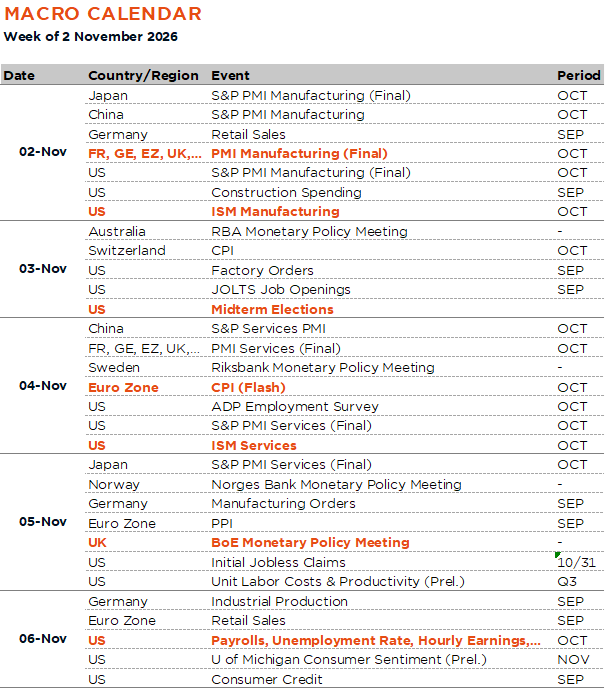
Welcome to November! For those who survived Halloween, and weren’t too spooked by the outcome of Brazil’s election or recent tech rout, a few tricks and treats still lie ahead. First up are Tuesday’s US midterm elections, which bring plenty of uncertainty: whatever the scenario you are considering, the market reaction is hard to call. On the macro front, the final October global PMIs are due, along with the US ISM indices: manufacturing on Monday and services on Wednesday. The US October jobs report will close the week on Friday. Consensus expects payrolls to rise by 60k (after +29k in September), with the unemployment rate stable at 4.2%. Hourly earnings are seen reaccelerating to +0.3% MoM from +0.1%, while staying close to 3% YoY. Before that, we will get other gauges of the US labor market, including the September JOLTS data (Tuesday) and the October ADP report (Wednesday).
Elsewhere, the RBA (Tuesday, +0.25% hike to 4.85% expected), Riksbank (Wednesday, +25bps hike to 2% expected), Norges Bank (hold at 4.5%) and BoE (Thursday, +25bps hike to 4% expected) will set rates, while German industrial production and factory orders will hit our screens later in the week. Last but not least, earnings season remains in full swing, especially early in the week, with results from Apple (Monday); Shopify, Pfizer, Ferrari and AMD (Tuesday); and Uber, Novo Nordisk, McDonald’s and Qualcomm (Wednesday), among many others.
This is a marketing communication issued by DECALIA SA. It is neither directed to, nor intended for distribution or use by, any person or entity who is a citizen or resident of or located in any locality, state, country or jurisdiction where such distribution, publication, availability or use would be contrary to law or regulation. The information and data presented in this document are not to be considered as an offer or invitation to buy or sell any securities or financial instruments nor to subscribe to any services. The information, opinions, estimates, calculations etc. contained in this document reflect a judgment at the original date of publication and are subject to change without notice. Investments in any securities or financial instruments may not be suitable for all recipients and may not be available in all countries. This document has been prepared without taking account of the objectives, financial situation or needs of any particular investor. Before entering into any transaction, investors should consider the suitability of the transaction to individual circumstances and objectives. Any investment or trading or other decision should only be made by the client after a thorough reading of the relevant product term sheet, subscription agreement, information memorandum, prospectus or other offering document relating to the issue of the securities or other financial instruments. Where a document makes reference to a specific research report, the document should not be read in isolation without consulting the full research report, which may be provided upon request.