
It’s currently hard to hold tactical convictions on markets, given the many uncertainties related to (1) the gyrations of the US-Iran war, which influence the trajectory of energy prices and, by ripple effect, the stance of monetary policy, and (2) the AI theme dominating headlines, driving dispersion within the IT sector and concentrating risk. In the meantime, investors seem convinced that economic activity will remain resilient going forward: according to the latest BofAML survey, only 2% expect a hard landing in the coming months, while more than 50% don’t see any landing at all.
No Hard Landing largely expected
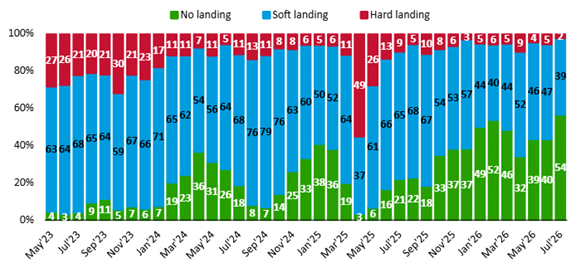
Source: BofAML latest survey
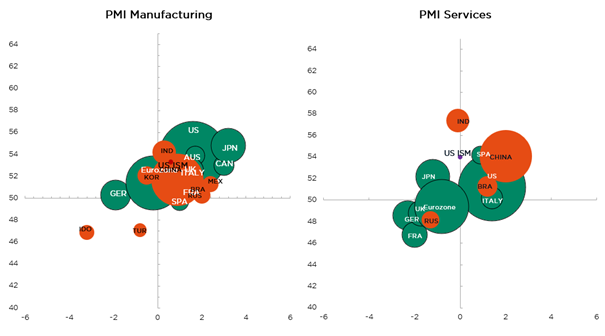
One of the reasons, which we have underlined several times since the end of last year, is the investment boom driven by AI capex and broader spending on national security, self-reliance, and infrastructure upgrades, funded by both private companies and governments. That’s why we are experiencing a new global industrial cycle, with manufacturing PMIs currently outperforming services PMIs in both level and trend — something rare enough historically to warrant attention to the diverging dynamics between resilient manufacturing (AI capex, defense, energy infrastructure, etc.) and services muddling through amid uncertainties from the Iran conflict and weaker consumer demand.
Mind the diverging trends: accelerating manufacturing vs. muddling through services
In the same vein, our ISM manufacturing model forecasts a July reading above 60 (data due out next Monday), as shown last week in this column (“Inflation and Growth in a time of Innovation and Geopolitical Tensions”). Another striking illustration of the current industrial boom is the valuation of this equity sector, which has had a strong run over the past year: industrials are trading at their highest level in 20 years, even outpacing other sectors, including IT, which has somewhat de-rated over the past two years (valuations came down as earnings grew faster than share prices rose).
Global Sector/Factor 20Y Valuation (12M Fwd P/E)
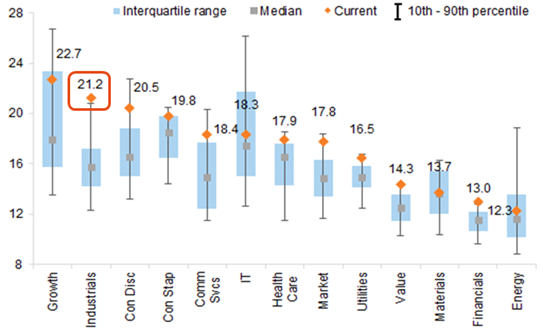
Source: Goldman Sachs
Turning to consumers: while somewhat weaker, constrained by lower purchasing power, consumer spending has nevertheless held up, particularly in the US, supported by tax refunds and a resilient labor market. The same holds true in Europe, where unemployment rates remain historically low (likely reflecting an ageing population, reduced immigration flows, and other structural trends at play). In fact, you may have noticed that « unemployment » has almost disappeared from the list of priority issues in European economic policy since the end of Covid, often replaced by « purchasing power« .
Consistent with this backdrop of resilient growth and still-elevated inflation, investors no longer expect rate cuts or central bank easing over the next 6–12 months.
The tide turned… Expectations of major central banks cumulative rate cuts/hikes for the rest of the year
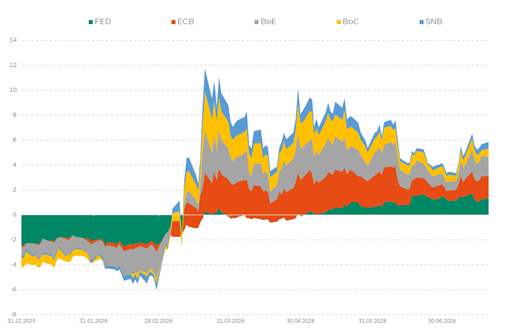
Zooming in on the Fed, investors are currently pricing in two rate hikes, backloaded over the next six months, according to Fed Funds futures. The tide has clearly turned, given that they were expecting three rate cuts at the start of the year.
Implied overnight rate & number of hikes/cuts
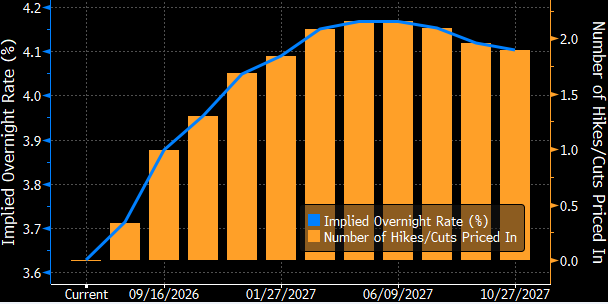
That said, we would be wary of taking these odds of hikes at face value. We are not calling for an imminent recession, but a growth setback is far less improbable than investors currently assume. Two triggers could easily derail the current growth resilience narrative. First, energy prices could resume their climb in the coming months, hitting consumer spending in H2 with winter approaching and heating demand set to push bills higher again. Second, AI capex (the very engine of the current industrial cycle) could stall if financing costs keep rising, both through higher risk-free rates and widening credit spreads for the sector, especially if monetization of these massive investments continues to be pushed back, or fails to materialize altogether.
More broadly, certainties are made to be challenged, if not broken, sooner or later, markets have a way of testing them. Between lingering uncertainty on inflation and renewed doubts on growth at some point, it remains harder than ever to take strong directional bets on markets today.
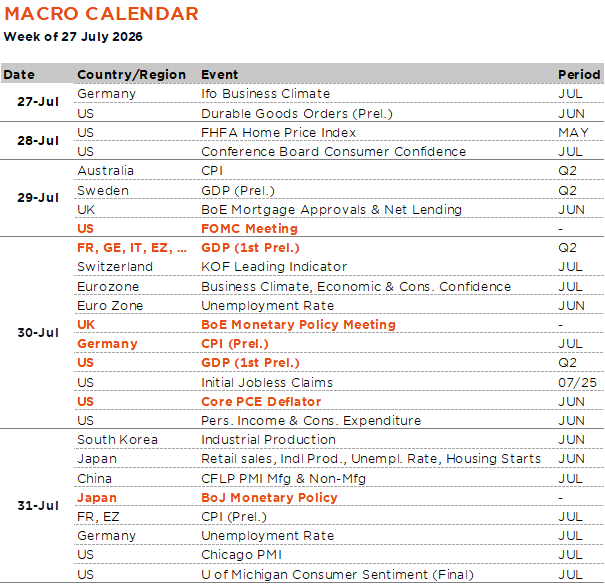
Economic Calendar
If you’re on vacation this week, you’ve a good timing… because the macro and micro calendars will be heavily packed and are already shaping up to be quite eventful. Between volatility and intra-sector rotations within the tech sector (software, semiconductors, and hyperscalers), geopolitical tensions and the oil prices rollercoaster, along with the rise in long-term interest rates to levels that younger generations have never seen before, we’ll need to make room to process and digest two main highlights, earnings and the Fed, and other key data, which certainly won’t reduce much volatility and current uncertainties. So, brace for a choppy and uneven markets’ path ahead.
Here’s the agenda for the week:
- Central bank meetings, with the Fed on Wednesday, the BoE on Thursday, and the BoJ on Friday. Although none of the three is expected to raise rates, the BoJ is the one that could surprise the consensus -just as it did almost exactly two years ago to the day (August 2nd 2024) given the now chronic weakness of the JPY. Indeed, beyond statements of intent and ad hoc interventions, only a less accommodative monetary policy (as BoJ remains definitively behind the curve) could truly help stabilize the situation. Consensus is already pricing in 36% chance of a rate hike in September, and 85% for October. As for the other central banks meeting in the coming days (i.e. the Fed and the BoE), we should also see a hawkish hold, with rates remaining unchanged at 3.5%–3.75% and 3.75%, respectively. It’s worth noting that investors estimate the probability of a Fed rate hike at its next meeting to be around 30%, compared to less than 10% for the BoE. Obviously, any further surge in energy prices over $100 in the coming days would dangerously increase these probabilities – or at the very least, the hawkishness of the statements and tone.
- GDP figures for the second quarter in the U.S. and Europe will be released on Thursday. The consensus forecast calls for 2.3% annualized growth in the United States (vs. 2.1% in Q1) and a slight increase in the Eurozone (+0.2% QoQ) following stagnation in the previous quarter, with Spain leading the way (+0.6% expected) and Germany (+0.1%) lagging behind. Positive surprises could, here as well, heighten pressure on long-term rates and accelerate monetary policy tightening. Conversely, poor figures would validate current central bankers “wait-and-see” approach.
- The US core PCE deflator for June (also on Thursday). Given the recent rebound in energy prices, it will certainly carry slightly less weight than usual – unless, again, it holds a negative surprise, namely that it comes in higher than expected (the consensus forecast is +0.1% M/M and +3.3% Y/Y). On the same day, we’ll also see the first inflation estimates for July in Germany, as well as in France and the eurozone the following day (Friday). Before that, Australia’s Q2 inflation figures will be released on Wednesday.
- Several important economic data releases in Europe (German IFO, Euro Area Business Climate Index, and unemployment rate), in Japan (June retail sales, industrial production, unemployment rate, and housing starts), and, of course, in the United States (durable goods orders, consumer confidence, and weekly initial jobless claims).
Finally, in terms of corporate earnings, we’ll have four major companies reports, which could move markets, namely Microsoft and Meta on Wednesday after the close, as well as Apple and Amazon on Thursday. We will also get a whole host of mega- and large-cap companies across various sectors. To name just a few, in no particular order: Altria, Coca-Cola, and Unilever (Consumer Staples); P&G and Starbucks (Consumer Discretionary); Chevron, Exxon, and Shell (Energy), Visa, Mastercard, S&P Global, UBS, and BBVA (Financials), GSK and Sanofi (Healthcare), and, of course, other tech companies (Qualcomm, Lam, ARM, etc.).
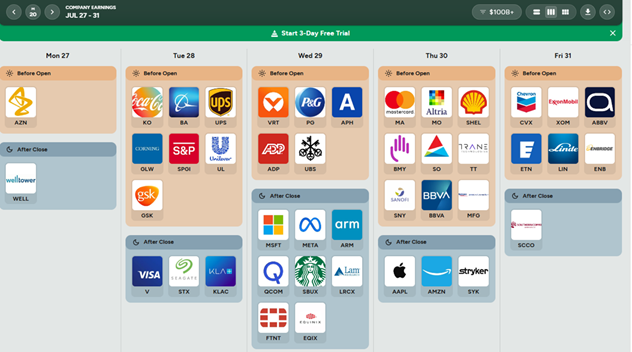
https://earningshub.com/earnings-calendar/week-of/2026-07-27
This is a marketing communication issued by DECALIA SA. It is neither directed to, nor intended for distribution or use by, any person or entity who is a citizen or resident of or located in any locality, state, country or jurisdiction where such distribution, publication, availability or use would be contrary to law or regulation. The information and data presented in this document are not to be considered as an offer or invitation to buy or sell any securities or financial instruments nor to subscribe to any services. The information, opinions, estimates, calculations etc. contained in this document reflect a judgment at the original date of publication and are subject to change without notice. Investments in any securities or financial instruments may not be suitable for all recipients and may not be available in all countries. This document has been prepared without taking account of the objectives, financial situation or needs of any particular investor. Before entering into any transaction, investors should consider the suitability of the transaction to individual circumstances and objectives. Any investment or trading or other decision should only be made by the client after a thorough reading of the relevant product term sheet, subscription agreement, information memorandum, prospectus or other offering document relating to the issue of the securities or other financial instruments. Where a document makes reference to a specific research report, the document should not be read in isolation without consulting the full research report, which may be provided upon request.